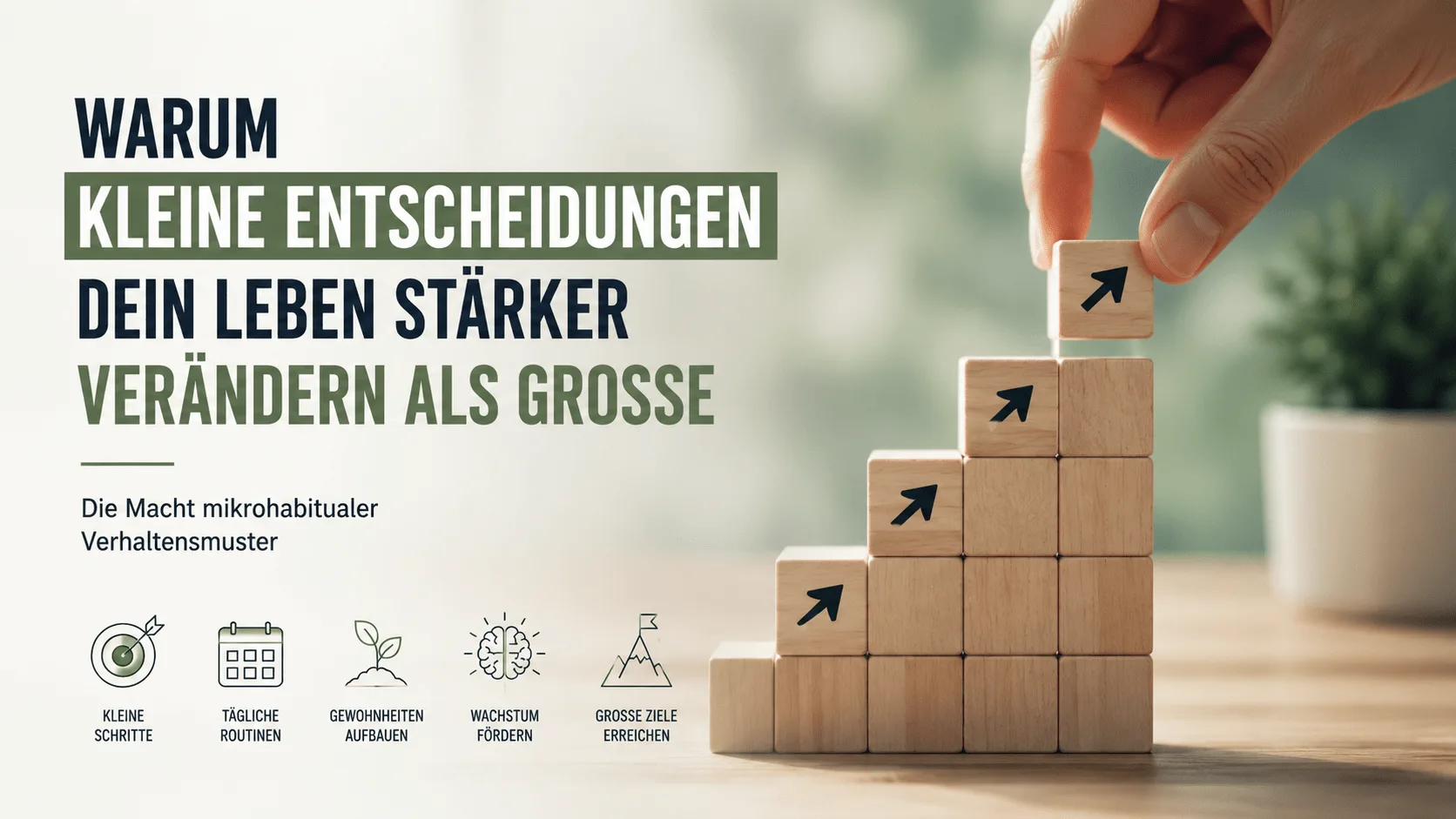
 Mentavo
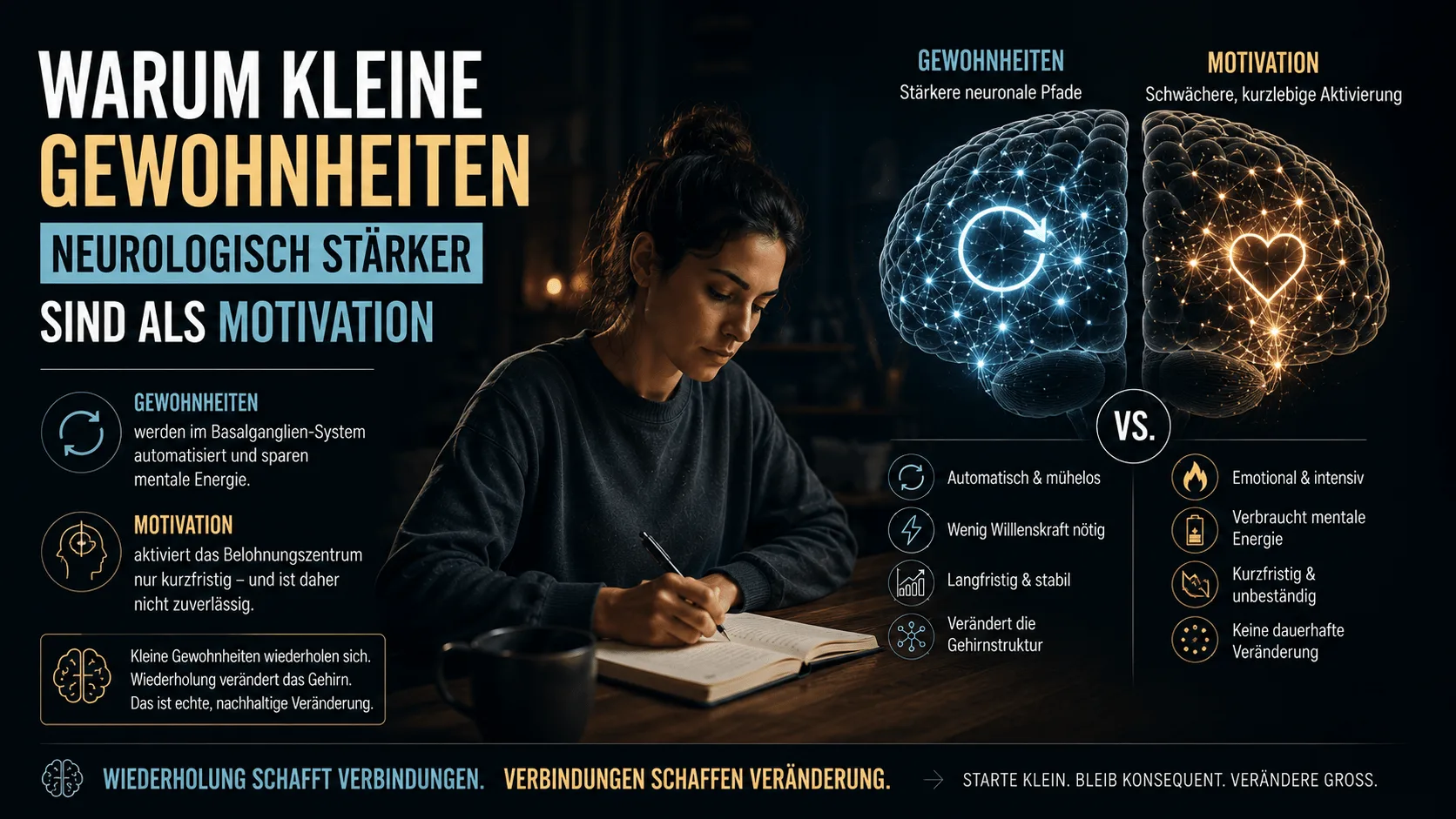
Most people overestimate motivation.
And underestimate repetition.
That's why so many changes begin with intense energy —
and end a few weeks later back in the same old reality.
A new plan.
A new routine.
A motivating video.
An emotional fresh start.
For a moment, everything feels possible.
People often think:
"Now I'm finally ready."
But that's exactly where the problem begins.
Because motivation feels powerful —
but neurologically, it's surprisingly unstable.
Habits, on the other hand, often feel unremarkable.
But that's exactly why they change people much more deeply in the long run.
Not because they're more emotionally intense.
But because the brain trusts repetition more than excitement.
Motivation is an emotional state — not a stable structure
Motivation is often romanticized.
People talk about motivation as if it were a special inner force.
But from a neurobiological standpoint, motivation strongly depends on:
- emotions
- energy level
- sleep
- stress
- environment
- hormones
- expectations
- dopamine
- mental exhaustion
That means:
motivation fluctuates constantly.
Some days, change feels easy.
Other days, even a small task feels overwhelming.
Many people misread these fluctuations.
They think:
"I'm lacking discipline."
But often, what's missing isn't discipline —
it's a stable neurological system.
People rely too heavily on emotions to sustain behavior.
But the brain prefers something else:
Automation.
The brain loves efficiency
The human brain uses an enormous amount of energy.
That's why it constantly tries to simplify processes.
Any action that gets repeated regularly costs less and less conscious attention over time.
That's the neurological core of habits.
At first, a new behavior requires:
- a conscious decision
- concentration
- energy
- resistance against old patterns
But repetition creates neural connections.
The brain recognizes:
"This behavior keeps happening. It seems to matter."
So it starts making that behavior more efficient.
Over time, conscious effort turns into something automatic.
That's why established habits often feel self-evident.
Not because people suddenly became more motivated.
But because the brain wants to save energy.
Small habits fail less often because they don't overwhelm the nervous system
Many people try to change through intensity.
Suddenly:
- completely new routines
- radical goals
- maximum self-optimization
- daily peak performance
But the nervous system often responds to extreme change with resistance.
Why?
Because the brain prefers stability.
Changes that are too big create:
- mental overload
- stress
- a loss of control
- emotional friction
And it's exactly this friction that often causes people to give up.
Small habits, by contrast, seem harmless.
Almost insignificant.
But neurologically, they have a huge advantage:
They bypass the inner alarm state.
A small action creates little resistance —
but still creates repetition.
And repetition changes the brain more powerfully than short-term intensity.
Dopamine has been misunderstood
Dopamine is often oversimplified.
Many believe:
"Dopamine is the happiness hormone."
But dopamine is far more complex.
From a neuroscience perspective, dopamine is mainly linked to:
- expectation
- learning
- motivation
- reward prediction
- behavior reinforcement
The brain doesn't only release dopamine when people achieve something.
Dopamine often arises already at the expectation of a possible reward.
That explains why:
- social media can become addictive
- notifications are so effective
- people constantly reach for their phone
- short-term stimuli feel so powerful
The brain loves predictable reward loops.
And that's exactly where habits form.
Habit loops: how behavior gets stored neurologically
Many habits follow a simple pattern:
- trigger
- behavior
- reward
Psychologists call this a "habit loop."
Example:
- stress → open phone → short-term distraction
- boredom → social media → dopamine hit
- uncertainty → check messages → feeling of control
With every repetition, the brain strengthens the neural connection.
The behavior becomes faster to trigger.
At some point, the person reacts automatically.
Not consciously.
Automatically.
That's why people often reach for their phone before they even notice they're stressed.
The brain learns:
"This behavior reduces tension in the short term."
And that's exactly how stable patterns form.
The problem with modern habits
The modern world is full of artificial habit loops.
Apps, platforms, and digital systems constantly compete for attention.
They use exactly the same neurological mechanisms:
- variable rewards
- dopamine cycles
- repetition
- emotional triggers
- automatic response patterns
That means:
many people train their brain every day —
just often without realizing it.
Every scroll.
Every notification.
Every quick stimulus.
The brain keeps learning:
"This deserves attention."
That's why some people feel permanently restless today.
Not because they're weak.
But because their nervous system has been trained for constant stimulation.
Small habits shape identity
The greatest power of small habits doesn't lie in the behavior itself.
It lies in the identity that forms through repetition.
People rarely change through single big decisions.
They change through small, repeated pieces of evidence about who they are.
If someone writes regularly, this eventually forms:
"I'm someone who reflects."
If someone trains regularly:
"I'm someone who takes care of themselves."
If someone regularly pauses on purpose:
"I'm someone who's aware of themselves."
The brain observes behavior —
and builds self-images from it.
That's why small habits are so powerful.
They seem inconspicuous.
But they slowly change a person's inner story.
Why motivation often disappears after just a few days
Motivation often arises from emotion.
An inspiring moment.
A point of pain.
A fresh start.
A vision.
But emotional intensity is biologically hard to sustain permanently.
The brain normalizes almost everything.
Even strong motivation.
That's why many goals suddenly feel heavier after a short time.
Not because people are incapable.
But because the brain starts distributing energy more efficiently.
Anyone who relies only on motivation experiences constant emotional swings as a result:
- extremely focused today
- exhausted tomorrow
- motivated again after that
- lost again after that
Habits sidestep this problem.
They reduce your dependence on emotional state.
Consistency changes the brain more deeply than intensity
Neurologically speaking, change mainly comes from repetition.
Every repetition strengthens neural connections.
The brain follows a simple principle here:
"Neurons that fire together wire together."
The more often certain thought or behavior patterns get activated, the more stable they become.
That applies to:
- self-criticism
- fear
- focus
- calm
- gratitude
- reflection
- distraction
- habits
The brain is always training.
The only question is:
on what.
That's why small daily actions are often more powerful than rare, big changes.
Not because they're more spectacular.
But because they get anchored more deeply, neurologically.
People overestimate radical transformation
Modern self-improvement culture loves extremes.
"Change your life in 30 days."
"The perfect morning routine."
"Maximum productivity."
But real psychological change is usually much quieter.
Slower.
Less spectacular.
More repetitive.
The problem:
slow change often feels meaningless.
People barely notice small pieces of progress.
But the brain works exponentially over the long run.
Tiny repeated processes produce enormous changes over months or years:
- mental stability
- emotional regulation
- self-awareness
- focus
- inner calm
- identity
Not suddenly.
But gradually.
The philosophical dimension of habits
Maybe people are made up less of big decisions —
and more of repeated small actions.
Because life isn't mainly shaped by individual dramatic moments.
It's shaped by what people repeat every day:
- thoughts
- routines
- reactions
- attention
- language
- behavior
The brain doesn't ask:
"What did you once want to be?"
It observes:
"What do you regularly repeat?"
And that's exactly where personality comes from.
Why self-change often starts with small rituals
A single conscious moment per day can be more neurologically significant than rare bursts of extreme motivation.
A few minutes of writing.
A short walk without distraction.
An honest reflection.
A conscious breath instead of an automatic reaction.
Actions like these seem small.
But they send the brain a signal:
"This matters."
And with every repetition, that signal grows stronger.
That's the real power of habits:
They don't just change behavior.
They change attention.
And attention, over time, shapes reality.
Maybe that's why people need less motivation — and more conscious repetition
The modern world trains people to constantly search for intense feelings:
motivation.
inspiration.
perfect energy.
But lasting change rarely comes from intensity alone.
It comes from repetition with meaning.
Small actions.
Again and again.
Quiet enough to seem inconspicuous.
Strong enough to slowly rebuild the brain.
Maybe real change, then, doesn't lie in spectacular fresh starts.
Maybe it lies in the small things people often underestimate —
but repeat every day.