 Mentavo

Finally, no appointments.
No urgent task.
There's actually time to relax now.
And yet, after just a few minutes, a quiet restlessness sets in.
Phone.
Email.
Tidying up.
Planning tomorrow already.
Just quickly getting something done.
The free hour you were looking forward to suddenly feels like: wasted time.
"I really should be doing something."
Even though the exact opposite was the plan.
Why doing nothing can feel uncomfortable
A day full of stimuli, demands, and small decisions keeps the mind in motion. Appointments, messages, open tasks, the next thing on the list — for large stretches of the day, there's almost always something demanding attention.
When that motion suddenly stops, what's left for a moment is: nothing. No task coming your way. No external trigger dictating the next action.
For a mind that's been running in "next step" mode for hours, that exact emptiness can feel unfamiliar — not because rest is inherently unpleasant, but because after a hectic day it's rarely immediately familiar.
When productivity becomes part of your self-image
There's a difference between two sentences that sound similar at first glance.
"I didn't get much done today."
And: "I wasn't good enough today."
The first sentence describes a state. The second judges the person.
When performance is tightly linked to your sense of self-worth over a long period, that distinction easily disappears. A quiet day is no longer experienced as quiet, but as evidence of a deficiency. This isn't a diagnosis, and it doesn't apply to everyone — but it describes a pattern that, when people look honestly, feels surprisingly familiar to many.
This pattern often doesn't appear suddenly, but builds over years: praise for achievement, recognition for results, rarely any feedback for simply existing. Over time, achievement becomes the most reliable source of feeling good about yourself — and standing still becomes correspondingly uncomfortable, no matter how badly it might actually be needed.
The hidden question behind many breaks
Behind seemingly simple moments of rest often lie unspoken questions:
- Have I done enough today?
- Am I really allowed to stop?
- Couldn't I use this time more usefully?
The word "allowed" is particularly telling here. It reveals that rest apparently needs permission — as if it were a privilege you first have to earn, instead of a basic need that's simply part of life.
Why even breaks become productive
A telling pattern of modern self-optimization: even rest is increasingly assigned a purpose.
Meditation, to be more productive afterward. Sleep, to become more capable. A walk, to work better again. Exercise, to have more energy for the next appointment.
None of these reasons is wrong. Movement, sleep, and rest generally do you good, no matter how you justify them.
But it gets interesting with the question underneath it all:
Is a break allowed to just be a break — without having to justify a later benefit?
Rest and distraction aren't the same thing
An hour of social media on the couch feels like a break. Whether it was actually restful is a different question.
Distraction and rest can feel similar, but they aren't necessarily identical. Distraction redirects attention without necessarily reducing the underlying tension. After an hour of scrolling, some people feel more exhausted than before — others do feel more relaxed. Both are possible, and blanket judgments about screen time or entertainment don't help much here.
The genuinely interesting question isn't so much which activity is "right," but rather: does this particular break actually feel more restful afterward — or just differently occupied?
Why rest can feel restless at first
After a hectic day, the mind often keeps running even though the body has long since stopped. Thoughts about open tasks, unsaid sentences from a conversation, tomorrow's list — all of it stays active, even when nothing more is happening on the outside.
This lingering isn't a malfunction. A system that's been geared toward activity for hours rarely switches over immediately just because the calendar is free. Knowing this makes people less likely to judge their own restlessness right after a demanding day as personal failure — and more likely to see it for what it usually is: a transition phase.
The paradox of self-optimization
Self-optimization tips over from growth into burden at a certain point — and that exact point also applies to rest. As soon as breaks themselves have to be optimized — the right meditation length, the perfect sleep routine, the most efficient recovery ritual — the very thing that makes rest what it is disappears: an area with no claim to optimization.
Not every structure is harmful here. But when even rest becomes a project, little remains that's truly free of expectations.
How to actually recognize real rest
A helpful distinction: rest usually doesn't feel immediately spectacular — it shows up more in hindsight, in a mind that can follow a thought all the way through without immediately jumping to the next one.
Distraction, by contrast, often leaves a diffuse feeling: time has passed, but not much has changed. Neither tension nor looping thoughts have really lessened — only the clock has moved.
That doesn't mean every form of entertainment is worthless. But it's worth occasionally taking a closer look, instead of automatically counting every free hour as a "break" just because there's no task attached to it.
Maybe you don't need more free time — you need a different kind of break
A packed calendar isn't automatically the problem. Some people with little free time feel surprisingly balanced. Others have plenty of free hours and still feel like they never really switch off.
The difference rarely lies in the sheer amount of free time. It lies more in whether that time is actually experienced as mental relief — or just as an absence of appointments, while the mind keeps working in the background.
Observe what happens before your exhaustion
A single restless evening doesn't say much. It gets more interesting when, over a longer period, it becomes visible which situations reliably cost energy — and which actually give something back.
Sometimes it's a particular type of appointment. Sometimes a combination of too little sleep and a packed day. Sometimes a thought that's been running in the background for days without ever being consciously addressed. From the distance of a single evening, connections like these are hard to spot — that takes a comparison across several weeks.
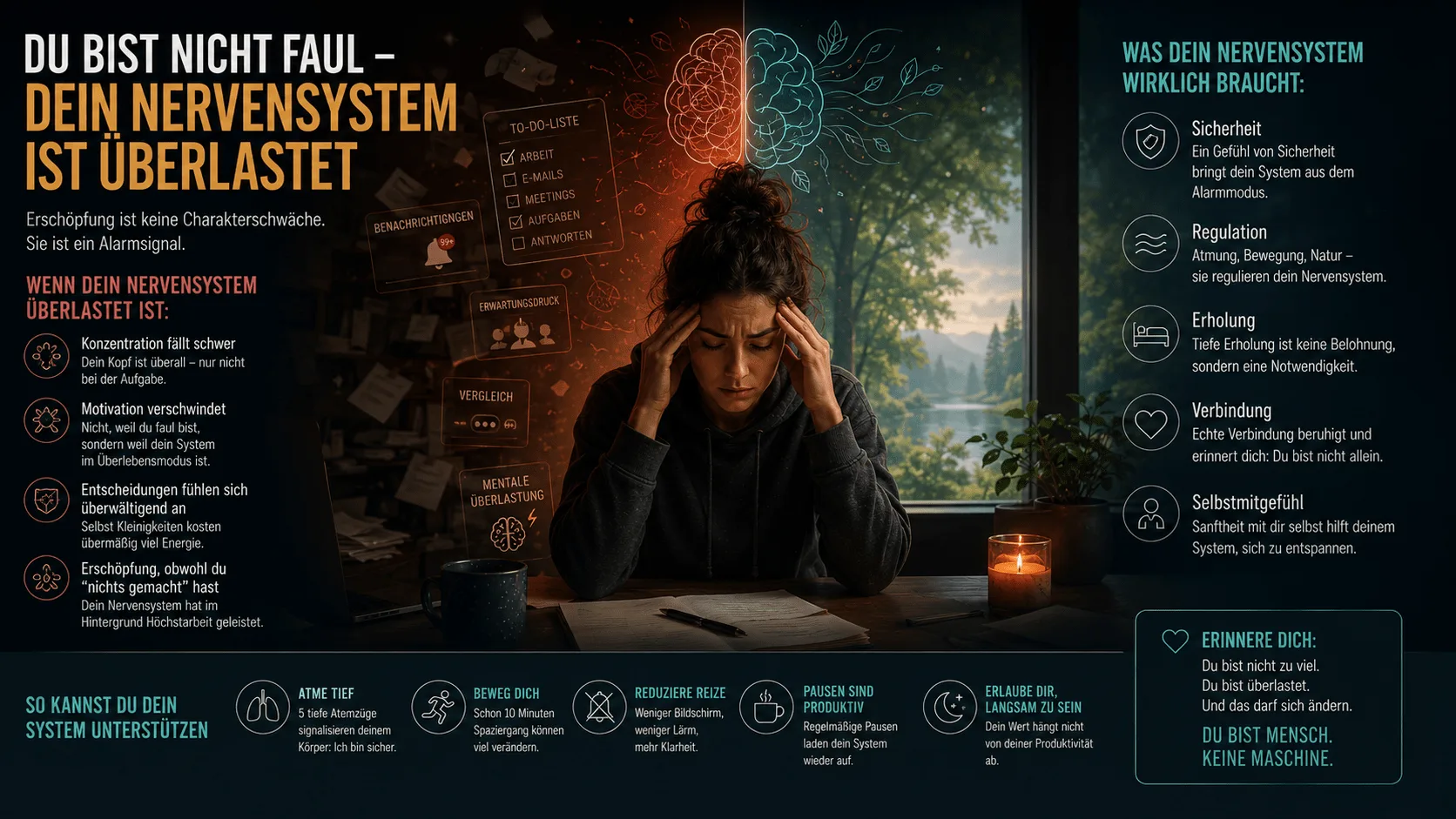
This is exactly where it becomes visible how closely exhaustion is tied to the nervous system rather than a lack of discipline. Anyone who observes over weeks what regularly precedes a feeling of exhaustion often finds clearer answers than in a single evening.
This is exactly where Mentavo can help — not as a diagnosis, but as a way to look at check-ins, journaling, routines, goals, and coaching conversations together over time: What costs energy? What gives energy back? When does exhaustion show up more often? And which kind of break actually feels regenerating afterward, rather than just interrupting?
Four reflection questions
For the next moment a break feels wrong:
- What do I believe I should be doing instead right now?
- Does this task really need to get done right now?
- Would I grant someone else the same break?
- Do I actually feel more rested after this activity?
The third question in particular often brings surprisingly much to light. What seems obvious for other people isn't always granted to yourself.
You don't have to earn rest
Not every free minute has to produce progress.
Not every break has to pay off later to be justified.
Sometimes the first step toward real rest isn't a new technique or a better ritual.
It's the quiet permission to simply not achieve anything for a few minutes.