 Mentavo
Many people call themselves lazy,
even though they're already exhausted on the inside.
They sit in front of tasks and can't concentrate.
They put off things that actually matter to them.
They feel guilty even though they barely have any energy left.
They want to start — and at the same time feel resistance to everything.
So they think:
"What's actually wrong with me?"
The modern world has taught people
to morally judge every form of exhaustion.
If you're productive, you're disciplined.
If you're tired, you're weak.
If you're not functioning, you lack willpower.
But often, the problem isn't laziness.
Often, the problem is
that a human nervous system lives under permanent sensory overload —
and at some point starts
protecting itself.
Modern people no longer live in rest — they live in constant activation
The human nervous system was built for short-term stress responses.
Danger.
Flight.
Tension.
Recovery.
But the modern world works differently.
Today, activation never really ends.
People wake up and immediately reach for their phone.
Within a few minutes, the brain processes:
- messages
- information
- expectations
- notifications
- decisions
- comparisons
- artificial urgency
And before the day has even really started,
the nervous system is already in reaction mode.
The problem:
the body often doesn't clearly distinguish between physical danger and ongoing psychological strain.
A crowded inbox.
Constant availability.
Social comparison.
Emotional pressure.
Uncertainty about the future.
All of it activates stress mechanisms.
Not dramatic enough to cause panic —
but constant enough
to slowly wear a person down.
Overload often doesn't feel like stress
Many people expect
overwhelm to look loud.
Breakdown.
Crying.
Panic.
Burnout.
But chronic nervous-system overload is often much quieter.
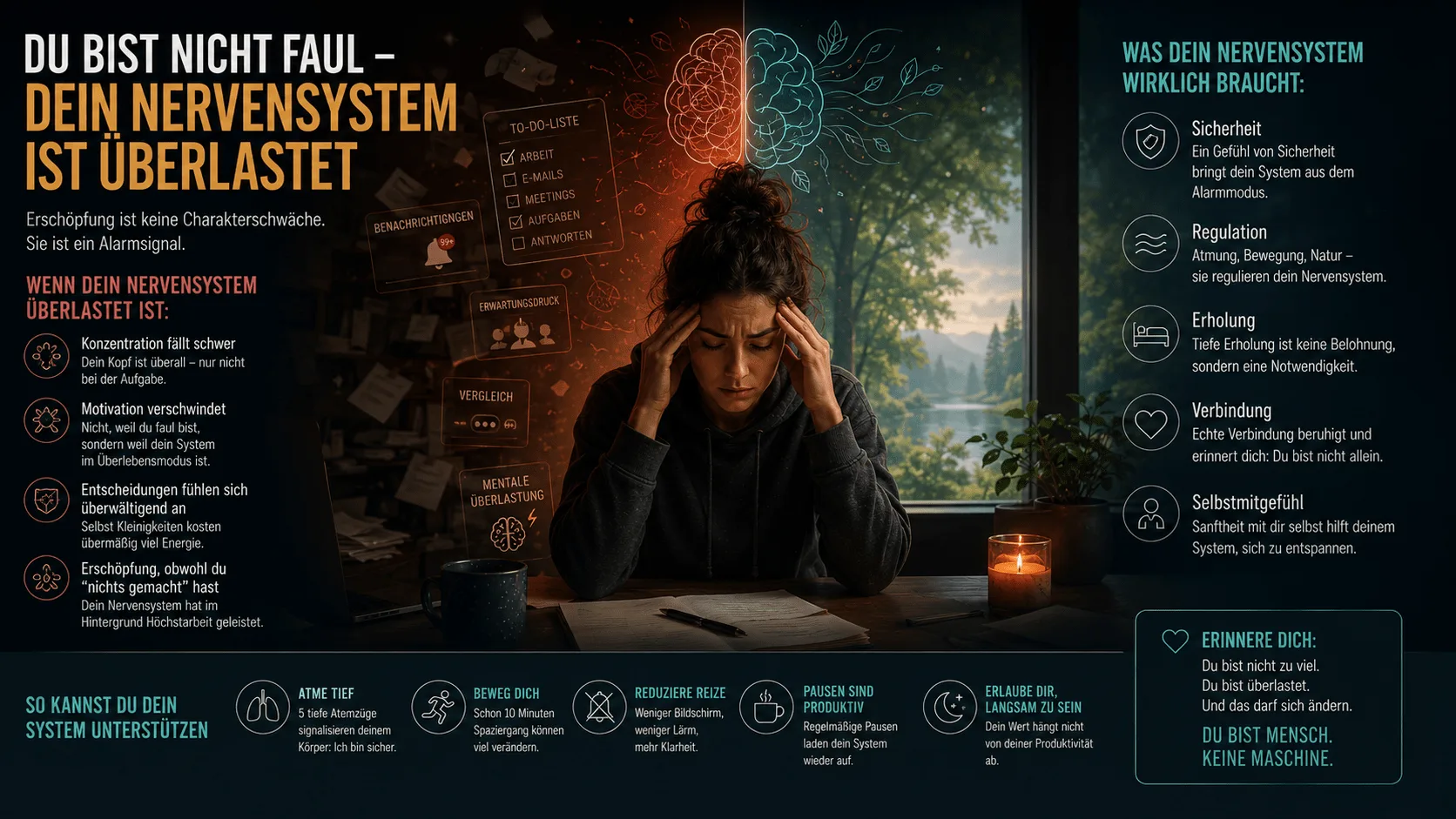
It shows up as:
- emotional numbness
- trouble concentrating
- procrastination
- inner emptiness
- irritability
- fatigue
- loss of motivation
- an inability to decide
From the outside, this quickly looks like laziness.
On the inside, it often feels like:
"I just can't anymore."
Not physically.
Neurologically.
Eventually, the brain switches to power-saving mode
The nervous system has one central task:
Ensure survival.
Not happiness.
Not productivity.
Not self-optimization.
Survival.
When the brain processes too many stimuli for too long,
it starts conserving energy.
This often happens unconsciously.
People then lose:
- drive
- focus
- emotional intensity
- mental flexibility
Not because they're weak.
But because the nervous system is trying
to keep functioning with limited resources.
Psychologically speaking, this isn't a character flaw.
It's adaptation.
The body is saying:
"We can't keep going like this indefinitely."
Why even small tasks suddenly feel overwhelming
Many people eventually reach a strange state:
Even simple things suddenly feel hard.
Replying to a message.
Scheduling an appointment.
Doing housework.
Starting a task.
Not because the task is objectively difficult.
But because the nervous system has no free capacity left.
The brain then evaluates even small demands as additional strain.
People think:
"Why can other people handle this and I can't?"
But often they're only seeing behavior —
not the inner strain behind it.
No one sees:
- mental exhaustion
- emotional pressure
- constant self-criticism
- underlying fear
- chronic stress
- inner overactivation
All of that costs energy.
Invisible energy.
The modern world confuses exhaustion with a lack of discipline
Many people live permanently beyond their natural capacity —
and then wonder
why they no longer feel motivated.
But motivation is hard to generate in an overstimulated nervous system.
In states of stress, the brain doesn't prioritize growth.
It prioritizes safety.
That's why people under overload often automatically reach for:
- distraction
- social media
- dopamine hits
- emotional withdrawal
- procrastination
- passive consumption
Not necessarily out of laziness.
But because the nervous system is looking for short-term relief.
The problem:
modern self-optimization culture usually responds with even more pressure.
More discipline.
More control.
More self-optimization.
But an overloaded nervous system rarely heals through additional inner warfare.
People aren't built for permanent self-optimization
The modern world creates a feeling
of never being enough.
There's always:
- more goals
- more productivity
- better routines
- more efficient systems
- more successful people
- new expectations
Psychologically, this creates a permanent state of inner alarm.
Many people never allow themselves real rest.
Even recovery gets optimized.
As a result, the nervous system barely receives any signals of safety.
And without safety, the body stays inwardly tense —
even in quiet moments.
That's why some people:
- can't switch off
- can't relax
- can't be present
- never really feel recovered
Not because they're incapable of rest.
But because their nervous system has forgotten
what safety feels like.
Procrastination is often emotional avoidance
Many people believe
procrastination is simply a bad habit.
But psychologically, something deeper is often behind it.
The brain isn't just avoiding work.
It's avoiding feelings.
Tasks can be unconsciously linked to:
- fear of failing
- fear of being judged
- overwhelm
- perfectionism
- inner pressure
- self-doubt
The nervous system then reacts not rationally.
But emotionally.
That's why people suddenly reach for their phone,
even though they actually wanted to work.
Not because they're "too lazy."
But because the brain wants to reduce stress in the short term.
Why rest today feels almost unfamiliar
Many people feel nervous
when suddenly nothing is happening.
No distraction.
No noise.
No content.
No stimuli.
Silence becomes uncomfortable.
Why?
Because in the quiet, things become audible
that get drowned out during the day:
- exhaustion
- loneliness
- emotional emptiness
- unresolved thoughts
- inner conflicts
That's why many people constantly consume new stimuli.
Not out of interest.
But as psychological escape.
This, however, keeps the nervous system permanently activated.
And that's exactly what deepens inner exhaustion over time.
The nervous system doesn't need more pressure — it needs safety
Many people try
to fight their exhaustion with toughness.
But the nervous system rarely responds well to constant self-criticism.
A person
who's constantly fighting against themselves internally
often lives in chronic tension.
Thoughts like:
- "I should be getting more done."
- "Why am I like this?"
- "I'm wasting my life."
- "Other people manage this just fine."
only add to the stress.
The brain doesn't interpret self-criticism as motivation.
Often, it interprets it as danger.
And danger triggers even more inner activation.
The truth is: many people aren't lazy — they're emotionally exhausted
Emotional exhaustion is hard to see.
People can, at the same time:
- function
- work
- keep appointments
- smile
- communicate
and still feel completely empty inside.
That's what makes modern overload so dangerous.
It often looks perfectly normal.
Many people only notice late
how long their nervous system has already been living in a state of emergency.
Healing often doesn't start with productivity — it starts with awareness
The first step often isn't:
achieve more.
It's recognizing:
"I'm not broken. I'm overloaded."
That distinction changes a lot.
Because people then start
to stop judging themselves only morally —
and start understanding themselves psychologically instead.
Suddenly, it becomes visible:
- why focus is missing
- why motivation fluctuates
- why rest feels hard
- why even small things are exhausting
Not everything is laziness.
Some of it is a nervous system
that's been trying, for far too long,
to keep functioning under permanent pressure.
Maybe that's why the modern world needs less self-optimization
And more nervous-system regulation.
More real rest.
More silence.
More self-reflection.
More emotional safety.
More conscious breaks.
More understanding for mental strain.
Because people aren't machines.
They're biological and emotional systems.
And every system eventually breaks down
when too much activation meets too little real recovery for too long.
That's exactly why platforms like Mentavo are becoming more important
Mentavo wasn't built
to put even more performance pressure on people.
But to create a space for:
- mental clarity
- self-reflection
- emotional processing
- AI journaling
- the development of self-awareness
- nervous-system awareness
Not as another productivity machine.
But as an intelligent space for reflection, for people
who want to understand themselves better again.
Because maybe people today don't need more motivation.
Maybe they first need inner safety again.