 Mentavo
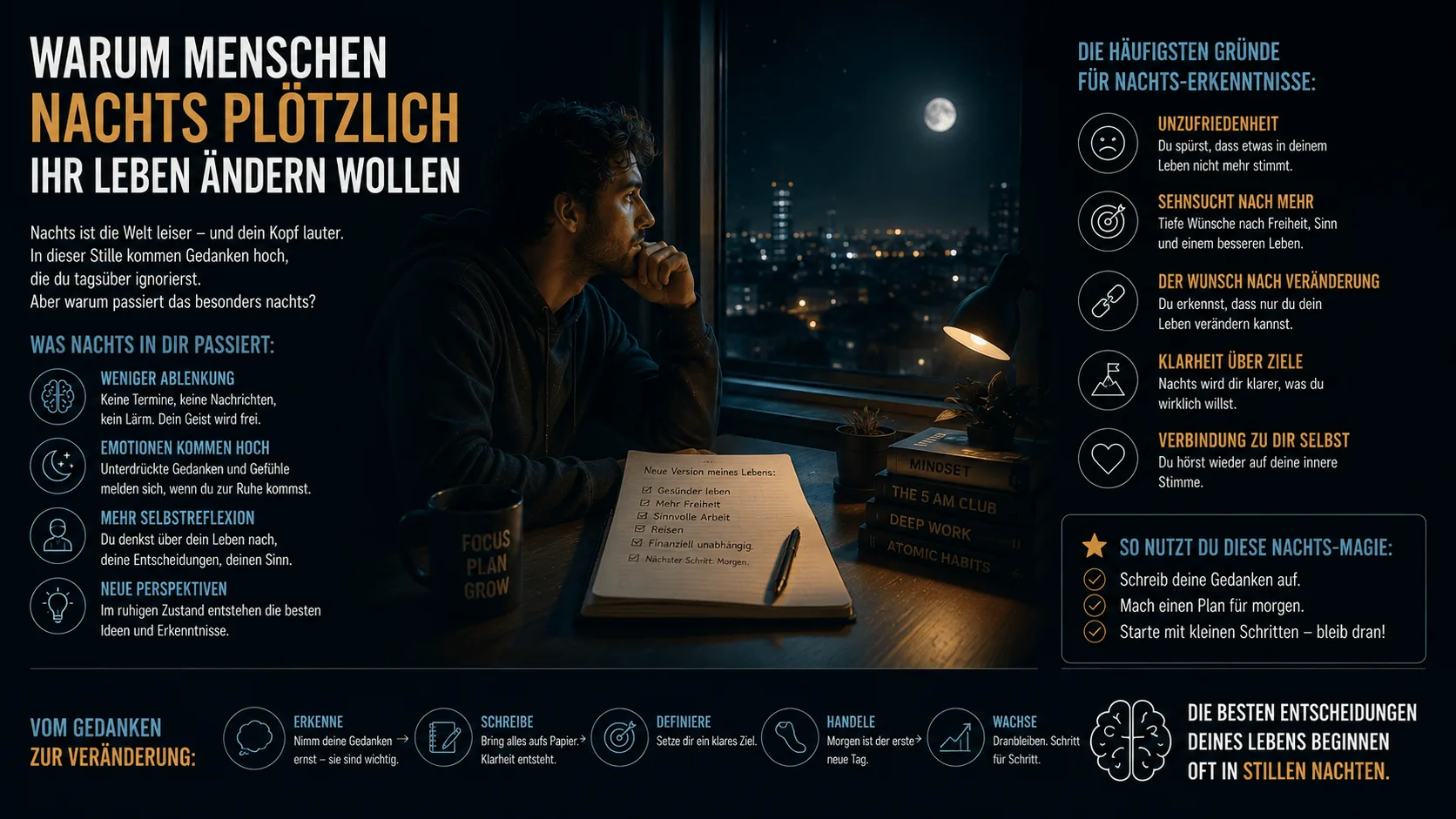
It often happens at night.
Not at noon in the office.
Not between meetings.
Not while scrolling through social media.
But somewhere between tiredness and silence.
Suddenly, someone is lying awake in the dark —
thinking things that were barely audible during the day.
"I don't think I'm actually happy."
Or:
"This can't go on like this forever."
Or:
"When did I actually stop feeling alive?"
The most honest thoughts a person has often arise at night.
And maybe that's no coincidence.
During the day, people function — at night, they meet themselves
Modern everyday life is loud.
Not just outwardly.
Inwardly too.
People constantly move between:
- work
- notifications
- conversations
- obligations
- stimuli
- distraction
- expectations
This keeps the brain constantly occupied.
And that's exactly what often prevents
deeper thoughts from really becoming conscious.
During the day, people mostly function in reaction mode.
Reply.
Get things done.
Scroll.
Keep going.
But at night, something changes.
The world gets quieter.
And suddenly, the constant layer of outside stimuli disappears.
The nervous system has less distraction.
As a result, inner processes become more audible.
At night, social roles slowly fall away
During the day, people play many roles at once.
Employee.
Partner.
Parent.
Friend.
Functioning adult.
Every role demands attention.
And every role produces a particular version of the self.
At night, these roles dissolve for a moment.
There are no more meetings.
No messages.
No expectations.
No performance.
Just a person and their thoughts.
That's exactly why questions often surface at night
that feel emotionally too distant during the day:
- Am I actually living the life I really want?
- Why do I feel empty despite success?
- Why am I constantly exhausted?
- When did I last feel real rest?
- Am I still connected to myself?
During the day, thoughts like these often get drowned out.
At night, they suddenly become loud.
At night, the brain processes unresolved emotional processes
From a neuroscience standpoint, the brain isn't simply "off" at night.
Quite the opposite.
Especially in quiet moments, the brain often starts
making open emotional processes more noticeable.
Thoughts that were suppressed during the day
suddenly resurface:
- insecurities
- unfulfilled wishes
- emotional exhaustion
- unresolved conflicts
- hidden longings
That's why many people experience a strange mix at night of:
- clarity
- melancholy
- honesty
- emotional intensity
Not because everything is more dramatic at night.
But because there's less distraction.
Why people suddenly want to "change everything" at night
Most people don't actually want to spontaneously wreck their life at night.
They want something else:
They want to escape the feeling
of being stuck inside.
At night, many people suddenly become aware
of just how automated their everyday life has become.
The repetition.
The routines.
The emotional distance.
Functioning without real connection.
And exactly in that moment, an intense desire for change often emerges.
Not necessarily rational.
But existential.
At night, people often long not for more success.
But for:
- meaning
- aliveness
- rest
- emotional authenticity
- inner clarity
The problem:
during the day, this feeling often fades again.
The morning often erases the honesty of the night
Many people know this moment:
At night, certain thoughts feel absolutely true.
The next morning, they suddenly feel far away.
Why?
Because in the morning, the brain returns to function mode.
Duties take back control.
Distractions start up again.
The nervous system switches back into routine.
The clarity of the night often gets pushed aside as a result —
not because it was wrong,
but because everyday life gets loud again.
That's why many people ignore their most honest thoughts for years.
Not on purpose.
But because modern life structures leave little room for inner reflection.
Fatigue lowers psychological protective mechanisms
A fascinating psychological effect is this:
Fatigue often makes people more honest.
Why?
Because mental exhaustion costs energy —
and protective mechanisms also require energy.
During the day, people constantly control:
- how they come across
- what they feel
- which thoughts they allow
- which emotions they suppress
At night, this control weakens.
The mind becomes more open.
Emotions rise more easily.
Thoughts feel more direct.
That explains
why people often suddenly, at night:
- write messages
- question decisions
- cry
- reflect
- analyze their entire life direction
It's not simply "overthinking."
Often, it's an unfiltered encounter with yourself.
The modern world produces emotional distance
Many people spend their day
reacting to all sorts of things —
except to themselves.
They consume:
- content
- opinions
- information
- entertainment
- productivity systems
But they rarely reflect
on how they're actually doing inside.
This creates a dangerous form of self-estrangement.
People keep functioning —
but slowly lose touch with their own needs.
At night, this distance sometimes suddenly collapses.
And that's exactly why quiet nights can feel emotionally overwhelming.
Why people often think about "another life" at night
At night, people often don't just think about problems.
They think about possibilities.
About alternative versions of themselves.
A quieter life.
A more honest life.
A more meaningful life.
A life with less inner pressure.
Maybe that's exactly why nighttime thoughts often feel so intense.
Because in these moments, people briefly sense
how far they've drifted from themselves.
The problem isn't the night — it's the missing space during the day
The night doesn't create these thoughts.
It just makes them visible.
Many people live so overloaded during the day
that real self-reflection barely has room to happen.
Only once quiet sets in
do inner tensions become audible.
That also explains
why people often long for rest —
and can barely stand silence at the same time.
Because in that silence, they encounter things
that have long been covered up.
That's exactly why spaces for reflection are becoming more important
In a world full of constant distraction,
places for honest self-reflection become more valuable.
Not just therapy.
Not just conversations.
But daily, conscious moments
in which people actually notice their thoughts.
That's exactly what Mentavo is for.
Mentavo wasn't built
just to make people more productive.
It's meant to create a space for:
- AI journaling
- emotional reflection
- mental clarity
- pattern recognition
- conscious self-observation
- honest thought processes
Especially at night,
when thoughts become more intense,
more honest, and more unfiltered,
a space for reflection can help
not simply push these inner processes back down —
but consciously notice and better understand them.
Maybe that's why people want to change their life at night
Not because they're irrational.
But because at night, what stays hidden during the day briefly becomes visible.
The exhaustion behind the functioning.
The longing behind the productivity.
The loneliness behind the distraction.
The inner emptiness behind outward success.
At night, the illusion often disappears
that constant busyness automatically creates meaning.
And that's exactly why questions like this arise:
"What do I actually need?"
Maybe there's no weakness in these moments.
Maybe that's where the most honest version of your own awareness lives.
Maybe at night it's not really about changing everything
Maybe it's about
finally hearing again
what's been trying to be said inside for a long time.
Because sometimes the night isn't the place
where people become dramatic.
It's the one place
where, for a brief moment, they stop
running away from themselves.