 Mentavo
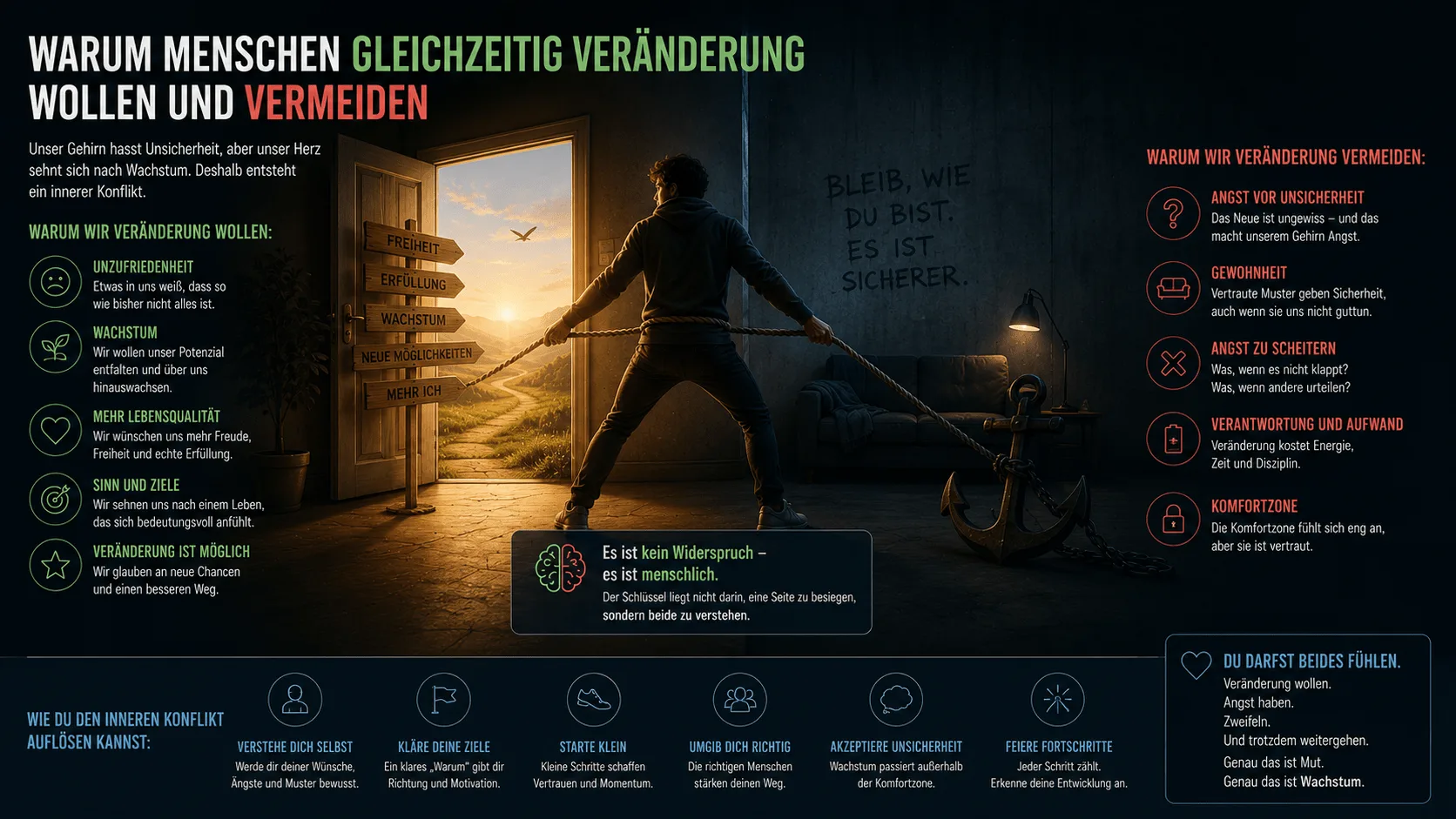
Almost everyone knows this inner contradiction.
Part of us wants change.
Another part fights against it.
People say:
"I finally want to change something."
And at the same time:
- they stay in the same routines
- they postpone decisions
- they sabotage their own progress
- they return to old patterns
- they feel resistance against the very things that would actually be good for them
From the outside, this often looks irrational.
Why does someone stay in a life that exhausts them?
Why do people hold on to relationships that hurt them?
Why do people avoid opportunities they actually long for?
The simple answer would be:
laziness.
fear.
lack of discipline.
But the truth runs much deeper psychologically.
People often want change and fear it —
at the same time,
on a level they're barely conscious of themselves.
The brain loves predictability more than happiness
Many people believe
the brain wants to make them happy.
But biologically speaking, the nervous system's most important task is:
Survival.
And evolutionarily, survival mainly meant:
predictability.
The brain often automatically rates familiar situations as safer —
even when they're unhealthy.
That's why people sometimes stay:
- in unhappy relationships
- in emotional exhaustion
- in self-destructive routines
- in jobs they don't love
- in a state of inner stagnation
Not because they like it.
But because the familiar seems neurologically less threatening than the unknown.
That sounds paradoxical.
But to the nervous system, familiar pain can feel safer than unfamiliar freedom.
Change threatens identity
Most people underestimate
how deep change actually reaches.
It's rarely just about new habits.
Change often means:
- a new identity
- new roles
- new relationships
- new expectations
- new uncertainties
When someone starts to really change,
it's not just behavior that shifts.
The entire self-image is set in motion.
And that's exactly what can trigger fear.
Because identity provides psychological stability —
even when it's painful.
That's why some people feel inwardly destabilized
as soon as real change begins.
Not because they want to fail.
But because the brain is trying
to protect a familiar version of the self.
People often don't sabotage their goals — they sabotage their uncertainty
Many forms of self-sabotage look irrational from the outside.
People:
- put off opportunities
- abandon progress
- suddenly lose motivation
- return to old patterns
But often, people aren't sabotaging success itself.
They're sabotaging the feeling of uncertainty
that success or change might bring with it.
Because real change raises questions like:
- Who am I without my old patterns?
- What happens if I become visible?
- What if others suddenly see me differently?
- What if I fail?
- What if I become successful — and still feel empty?
These fears often run unconsciously.
But the nervous system reacts to them anyway.
People are emotionally attached to old versions of themselves
Even painful patterns often have emotional roots.
A person
who's constantly overworked
may not even know any other form of self-worth.
A person
who always functions for other people
may be afraid
of no longer being lovable without that role.
A person
who constantly makes themselves small
may have learned
that being visible is dangerous.
Change then doesn't just mean progress.
It means loss.
Loss of an old identity.
And sometimes the brain grieves
even for patterns that actually hurt people.
The modern world sells change as if it were just a motivation problem
Social media loves simple narratives.
"You just have to really want it."
"Leave your comfort zone."
"No excuses."
"Discipline beats everything."
But this view ignores
how complex human psychology really is.
People aren't made up only of rational decisions.
They're made up of:
- nervous systems
- emotional memories
- protective mechanisms
- fears
- identity patterns
- social experiences
That's why change rarely happens in a straight line.
People make progress —
and fall back.
They want to grow —
and seek safety at the same time.
Both exist simultaneously.
And that's exactly what makes change so emotionally exhausting.
The nervous system often interprets uncertainty as danger
When people start something new,
something interesting happens neurologically.
The brain loses predictability.
And a lack of predictability activates stress.
That's why even positive changes can sometimes feel uncomfortable:
- a new job
- emotional openness
- new relationships
- new routines
- personal growth
People then often think:
"Maybe I don't actually want this."
Meanwhile, the nervous system often just wants
to go back to familiar stability.
Not because growth is wrong.
But because uncertainty biologically costs energy.
Many people confuse emotional safety with standing still
There's a reason
why some people dream about change for years —
but never really act on it.
The fantasy of change feels safer than real change.
As long as a dream only exists in your head,
nothing needs to be risked.
No rejection.
No failure.
No uncertainty.
No real confrontation with yourself.
But once change becomes real,
the nervous system starts building resistance.
That's why many people live permanently caught between:
- longing for growth
and - fear of movement
Why people suddenly seem braver at night
Many people suddenly feel, at night,
the urge to change their entire life.
Why?
Because at night:
- distraction gets quieter
- social roles get weaker
- emotional awareness gets stronger
For a brief moment, people hear more clearly
how exhausted or disconnected they actually feel.
But the next morning, the brain's safety program often takes over again:
routine.
familiarity.
predictability.
The nighttime honesty disappears again under the daily grind.
Healing often starts with understanding — not with toughness
Many people respond to their inner resistance with self-criticism.
"Why can't I follow through on anything?"
"Why am I like this?"
"Why do I always sabotage myself?"
But constant inner pressure often only increases nervous-system activation.
The brain doesn't feel safer because of it.
It feels more threatened.
That's why real change often doesn't start with toughness.
It starts with awareness.
With the moment
people recognize:
"Part of me wants to grow. Another part is trying to protect me."
That thought changes everything.
Because suddenly resistance is no longer seen only as weakness —
but as a psychological protective mechanism.
That's exactly why reflective systems like Mentavo are becoming more relevant
Many people barely understand their own patterns,
because they're living right in the middle of them.
That's exactly why Mentavo was built:
as an intelligent space for:
- self-reflection
- AI journaling
- emotional pattern recognition
- mental clarity
- long-term personal development
Mentavo isn't meant to simply "motivate" people.
It's meant to help
make inner connections visible:
- Why do certain patterns keep repeating?
- When does emotional resistance arise?
- Which fears lie behind procrastination?
- Why does change feel both right and threatening at the same time?
Because many people don't need more pressure.
They need more understanding of themselves.
Maybe the desire for change is something deeply human
People often sense intuitively
when their inner life is out of balance.
The desire for change rarely arises without reason.
It arises
when something inside says:
"This doesn't feel right anymore."
And yet another part stays hesitant.
Not because people are broken.
But because growth always means uncertainty too.
Maybe real change, then, isn't about eliminating fear
Maybe it's about
understanding
why fear exists in the first place.
Because people often aren't fighting their goals.
They're fighting:
- uncertainty
- loss of control
- emotional vulnerability
- new identities
- unfamiliar versions of themselves
And maybe growth begins exactly there,
where people stop
hating themselves for this inner contradiction.
People aren't contradictory because they're weak
People are contradictory
because the brain simultaneously wants:
- safety
and - development
And it's exactly between these two forces
that the whole drama of human change unfolds.
Maybe it's not about
never feeling afraid of change again.
Maybe it's about
slowly learning, despite that fear,
to stop standing in your own way.