 Mentavo
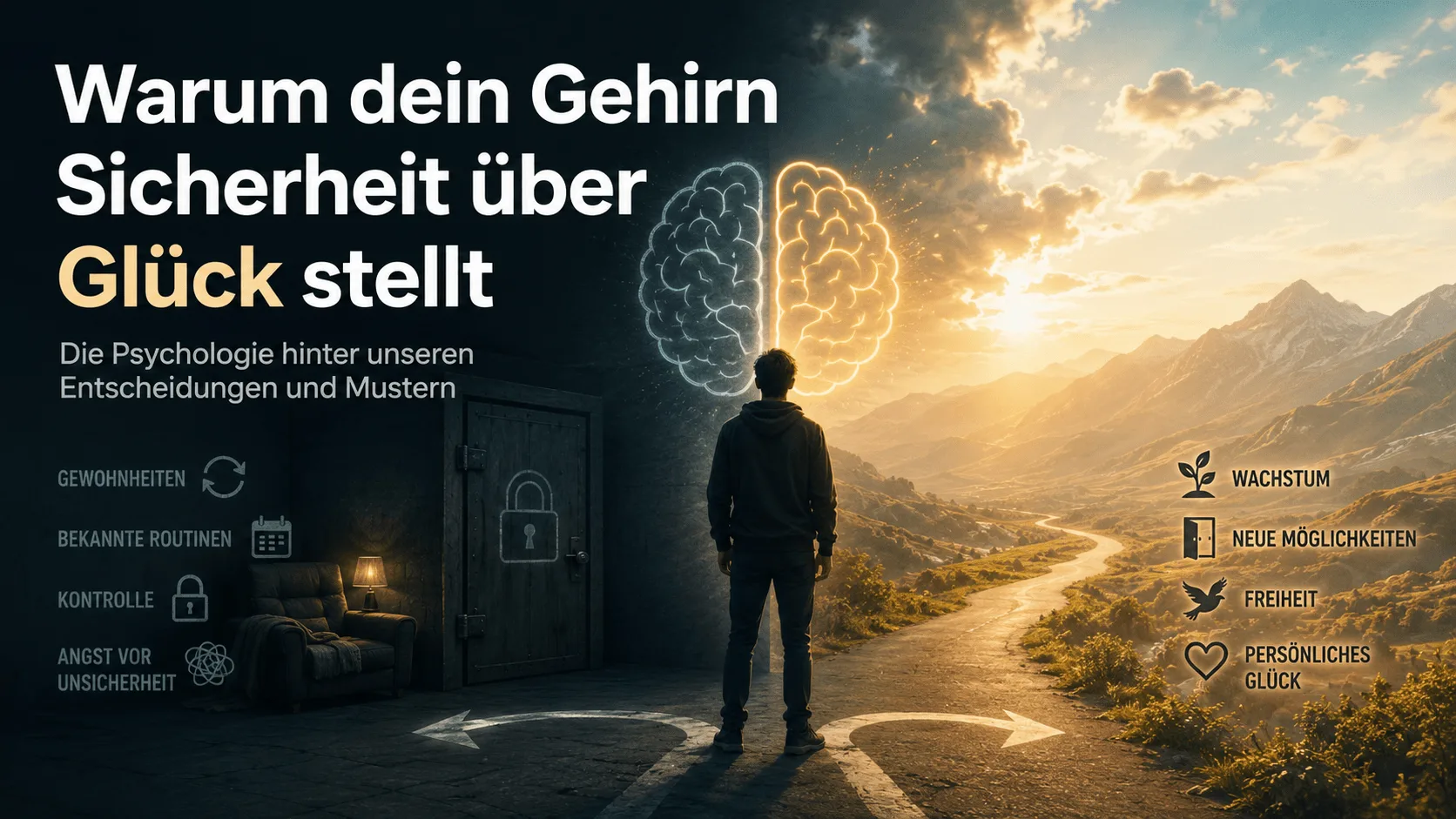
You probably know this feeling. You decide to change something in your life. Maybe you finally want to exercise regularly, look for a new job, end an unhealthy relationship, or make more time for yourself. You're motivated, you have good reasons, and you're convinced the change will positively affect your life in the long run.
But a few days or weeks later, you find yourself right back where you started. Old habits take over. The motivation disappears, and suddenly the old way of doing things feels surprisingly comfortable again — even though it made you unhappy before.
Many people interpret this as a lack of discipline or willpower. They believe they're simply not consistent enough. In reality, though, the cause runs much deeper. Your brain isn't pursuing the same goal you are.
While you wish for a happier life, your brain is mainly pursuing a different goal: safety.
That sounds contradictory at first. After all, don't we all want to be happy? But from your brain's point of view, happiness was never the top priority across millions of years of evolution. What mattered most was surviving. And survival mainly meant one thing: avoiding risk.
That's exactly why change often feels uncomfortable — even when it would objectively be good for us.
Why our brain wasn't built for happiness
Modern humans live in a world that changes faster than ever before. And yet our brain still operates on mechanisms that developed over hundreds of thousands of years.
Back then, every unfamiliar situation was potentially dangerous. New places could be home to predators. Strangers could be enemies. Unknown plants could be poisonous.
Those who were cautious had better odds of survival.
Our brain therefore learned a simple rule:
Familiar is safe. Unfamiliar is possibly dangerous.
This principle still shapes us today.
Of course, hardly anything today threatens us like a saber-toothed tiger. And yet our nervous system often reacts to change in similar ways as it did back then. A new job, a breakup, or a big step out of your comfort zone partly trigger the same warning systems in the brain that a real danger once did.
That doesn't mean change is actually dangerous. It just means your brain initially evaluates it as uncertainty.
Safety often feels better than freedom
Many people believe they'd always choose whatever makes them happier.
Reality often looks different.
One person stays in a job that exhausts them for years.
Another stays in a relationship they haven't been happy in for a long time.
Someone keeps living with bad habits, even though they know exactly how much harm those habits cause.
From the outside, this looks irrational.
From the brain's perspective, though, it makes sense.
Because the familiar has one decisive advantage:
It's predictable.
Our brain loves predictability. When it roughly knows what's going to happen next, it needs to spend less energy. At the same time, the feeling of possible threat decreases.
Happiness, on the other hand, is hard to predict.
A new career could turn out wonderfully — or fail.
A breakup could bring freedom in the long run — but loneliness in the short term.
The step into self-employment could succeed — or bring financial uncertainty.
For our brain, what matters first isn't the potential happiness a year from now.
It mainly evaluates the risk in the next few minutes.
The comfort zone isn't a happiness zone
Why we often misunderstand comfort
The term "comfort zone" is often misunderstood.
Many picture it as a place where you feel especially good. In reality, though, the comfort zone describes something else.
It describes the area your brain already knows.
That doesn't automatically mean this area is pleasant.
Constant stress can become a comfort zone too.
Ongoing self-criticism can feel familiar.
Chronic overthinking can feel normal.
Even loneliness or overwhelm can become your familiar reality.
When people say, "I don't even know why I keep falling back into the same patterns," this exact principle is often behind it.
The brain doesn't choose the better life.
It initially chooses the more familiar life.
Familiar doesn't mean healthy
A fascinating psychological effect is the so-called mere-exposure effect.
The more often we experience something, the more familiar it seems to us. And what's familiar, we often rate more positively — even when it's objectively not good for us.
That's why many people find it hard to let go of unhealthy patterns.
Not because they like them.
But because their brain has learned:
"I know this. This is what's kept me alive so far."
Why change can feel physically exhausting
Many people describe change as not just emotionally difficult, but also physically draining.
They feel tired.
Restless.
Tense.
Sometimes even exhausted.
There's a biological reason for this.
Our brain constantly works to conserve energy.
Habits help it enormously with that.
If you have the same routine every morning, your brain barely has to make decisions. Many processes run automatically.
Change works exactly the opposite way.
Suddenly, your brain constantly has to make new decisions.
Evaluate new situations.
Find new solutions.
Learn new behaviors.
That costs energy.
That's why the first weeks of a change often feel noticeably more exhausting than the state before it.
Not because you're on the wrong path.
But because your brain is currently building new connections.
The nervous system doesn't distinguish between real and perceived danger
Why even small changes can trigger stress
Many people are surprised that even positive events cause stress.
A new partner.
A move.
A promotion.
The birth of a child.
These are actually wonderful changes.
And yet many people initially react with nervousness or inner tension.
The reason lies in the nervous system.
Our autonomic nervous system doesn't perfectly distinguish between an actual danger and a situation that's merely new or unpredictable.
As soon as uncertainty arises, inner alertness often increases.
The heart beats faster.
Attention sharpens.
The body produces stress hormones.
This reaction is actually meant to protect you.
Unfortunately, it often leads people to abandon changes before they can even experience the positive effects those changes would have had in the long run.
Why setbacks are completely normal
Many people expect personal development to happen in a straight line.
One decision today.
A new life tomorrow.
In reality, change rarely works that way.
Our brain tests new behaviors carefully.
It constantly compares:
Is this new thing really safe?
Or should I go back to the old way?
That's why almost everyone experiences setbacks.
They aren't a sign of failure.
They're a normal part of how our brain learns.
Anyone who understands this stops seeing relapses as personal failure and starts seeing them as a natural part of a biological adaptation process.
Motivation rarely changes your life — identity does
Many people believe they simply need to be more motivated. So they consume books, podcasts, or inspiring videos. For a brief moment, they feel full of energy. But after a few days, that feeling disappears again, and everyday life takes back control.
The problem isn't a lack of motivation.
The problem is that motivation is an emotion — and emotions are fleeting.
Your identity, by contrast, is far more stable.
If you see yourself as someone who's not athletic, your brain will treat every workout as an exception. But if you see yourself as someone who takes care of their body, the meaning of that same action changes.
Suddenly you don't go work out because you're motivated.
You go because it's part of the person you want to be.
That's exactly why lasting change rarely starts with a new goal. It starts with a new view of yourself.
Why small decisions matter more than big resolutions
Our brain loves evidence.
Every small action sends it a message about who we are.
If you read ten pages of a book today, that doesn't create new knowledge instantly. But at the same time, you prove to your brain that you're someone who learns regularly.
If you write down your thoughts every evening, it's not just your journal that changes. You also strengthen the identity of someone who takes themselves seriously.
These small pieces of evidence work more powerfully in the long run than any short-term motivation.
That's why big changes often come from surprisingly small decisions.
How your brain learns new safety
The good news is: our brain is adaptable.
It prefers safety, but it can also learn to rate new situations as safe.
There's a term from neuroscience for this: neuroplasticity.
It describes our brain's ability to constantly reorganize itself through experience.
Every time you repeat a new behavior, new neural connections form. At first, these connections are still weak. That's why the new behavior feels unfamiliar.
But with every repetition, they become more stable.
At some point, something interesting happens.
What used to take effort suddenly feels natural.
Not because you developed more discipline.
But because your brain has since learned:
"This path is safe too."
Why patience is biologically necessary
In a world where we expect fast results, we often forget a crucial point.
Biological processes take time.
We sometimes expect our thinking to change within a few days.
But our brain doesn't work like a computer that simply installs a new program.
New habits form through repetition.
New emotional reactions form through experience.
New beliefs form because our brain gathers more and more evidence.
Personal growth is therefore not a single event.
It's a biological learning process.
What actually helps when you want to break out of old patterns
There are countless guides claiming you just need to toughen up.
Research paints a different picture, though.
Lasting change succeeds mainly when we help our brain build safety in the new.
Start smaller than your ego wants to
Many people set goals that excite them but also overwhelm them.
The nervous system often responds with resistance.
Small steps, by contrast, seem unspectacular.
That's exactly why they work.
Instead of deciding to work out for two hours every day starting tomorrow, start with ten minutes of movement.
Instead of wanting to read a whole book in one weekend, start with three pages.
The goal isn't to accomplish as much as possible.
The goal is to show your brain that change isn't dangerous.
Observe yourself instead of judging yourself
Self-criticism rarely creates lasting change.
It often just increases inner stress.
Someone who observes themselves with curiosity, on the other hand, recognizes patterns.
Why do I eat more in certain situations?
Why do I keep putting off exactly this task?
Why do I react so sensitively to criticism?
These questions shift the focus.
You stop fighting against yourself.
You start understanding yourself.
And understanding is often the first step toward real change.
Repetition beats perfection
Many people give up as soon as they experience a setback.
But that's exactly what prevents their brain from ever stabilizing new habits.
What matters, then, isn't perfection.
What matters is repetition.
Every return to a helpful habit strengthens the neural connections again.
Every small step counts.
Why self-reflection is the key to real change
Our brain works largely on autopilot.
A significant part of our daily thoughts, decisions, and actions runs unconsciously.
That's why it's often not enough to simply decide to act differently.
First, we need to recognize which patterns are actually at work inside us.
That's where self-reflection begins.
It creates distance between a thought and the reaction to it.
Instead of automatically following every emotion, a moment of pause suddenly appears.
That brief moment seems insignificant.
But it can actually decide whether we fall back into old habits or choose a new path.
Regular self-reflection, then, doesn't just change our thoughts.
Over time, it changes the way our brain makes decisions.
Why Mentavo focuses exactly here
Personal development doesn't mean motivating yourself anew every day.
It means understanding yourself better and better.
That's exactly where a tool that's more than an ordinary notebook can help.
Mentavo was built to make thoughts, feelings, and behavioral patterns visible. Through regular reflection, journaling, and AI-supported analysis, a clearer picture gradually forms of which situations trigger stress, which habits do you good, and which ways of thinking keep holding you back.
Over time, individual entries become a personal development story.
Instead of relying only on your memory, you can trace how your thoughts are changing, what progress you've made, and which patterns keep repeating over weeks or months.
This form of self-observation doesn't replace change.
But it makes change considerably more likely, because it continuously gives your brain new orientation.
Change doesn't begin with courage — it begins with safety
Maybe that's the most important thought in this entire article.
Most people don't fail because they want too little.
They don't fail because they're too weak, either.
Often, they simply fail because their brain is trying to protect them.
It holds onto the familiar, because the familiar has secured survival for thousands of years.
Once you understand this, your view of yourself changes.
You don't have to fight against your brain.
You're allowed to learn to work with it.
Every small decision, every conscious reflection, and every repeated action sends your nervous system the same message:
I am safe.
And at some point, something remarkable happens.
The life that used to feel frightening becomes the new normal.
Not because the world has changed.
But because your brain has changed.
Maybe personal growth, then, isn't about becoming a completely different person.
Maybe it's about showing your brain, again and again, that life is allowed to be bigger than the limits it once built to protect you.