 Mentavo
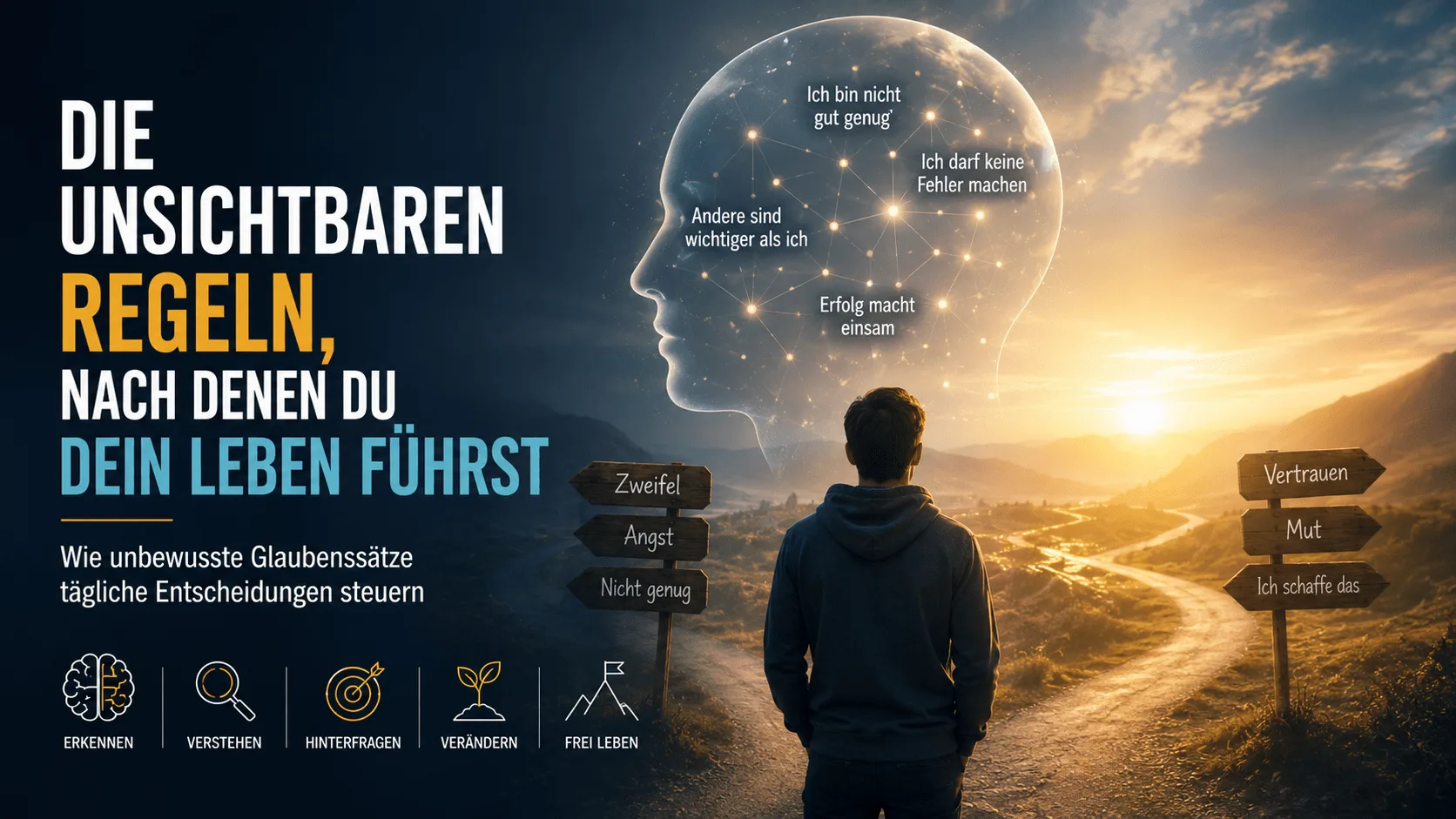
Most people believe they make their decisions consciously.
They think things through, weigh their options, and choose whatever seems most sensible.
But reality is often far more complex.
Beneath the surface of our conscious thinking, countless beliefs, assumptions, and inner rules are at work, shaping our behavior — often without us noticing.
These invisible rules determine:
- which opportunities we take,
- which risks we avoid,
- how we handle relationships,
- how we deal with money,
- how we react to criticism,
- which goals we even believe we're capable of.
Many of these rules were never consciously chosen.
And that's exactly why we rarely question them.
In this article, you'll learn what beliefs really are, how they form, and why they often have more influence on your life than motivation, knowledge, or talent.
You'll also learn how to recognize limiting beliefs and replace them, step by step, with more helpful alternatives.
What are beliefs, exactly?
Beliefs are mental convictions we hold to be true.
They act like internal rules or filters through which we view the world.
For example:
- "I have to be perfect."
- "Success means hard work."
- "I'm not creative."
- "Other people can't be trusted."
- "I'm not allowed to make mistakes."
- "I have to please everyone."
Some beliefs support us.
Others limit us.
The problem:
Most beliefs don't feel like opinions.
They feel like facts.
That's why we often don't question them.
Why beliefs are so powerful
Imagine two people are offered the same career opportunity.
Person A thinks:
"This is a great opportunity."
Person B thinks:
"I'm not good enough for this."
The situation is identical.
The reaction is completely different.
Why?
Because people don't react to reality.
They react to their interpretation of reality.
And that's exactly where beliefs come into play.
They influence:
- perception
- decisions
- emotions
- behavior
Often unconsciously.
How beliefs form
No one is born with beliefs.
They develop over many years.
Family
Many convictions already form in childhood.
For example:
- "Don't be so loud."
- "Pull yourself together."
- "Money doesn't grow on trees."
- "You have to achieve something to earn recognition."
Statements like these can leave a deep mark.
School and society
Our environment also shapes how we think.
Experiences with teachers, friends, or authority figures influence how we see ourselves.
Personal experiences
Especially emotional events often leave strong traces.
A single failure, for example, can give rise to the belief:
"I'm not talented."
Even though that conclusion is objectively untrue.
The invisible rules of everyday life
Many people only recognize their beliefs once they start paying closer attention to their thoughts.
Typical inner rules include:
"I always have to be strong."
Consequence:
Feelings get suppressed.
Help is rarely accepted.
"I'm not allowed to make mistakes."
Consequence:
Perfectionism and fear of new challenges.
"Other people matter more than I do."
Consequence:
People-pleasing and a lack of boundaries.
"I'm not good enough."
Consequence:
Self-doubt despite objective success.
"Success makes you lonely."
Consequence:
Unconscious self-sabotage.
Why knowledge alone is rarely enough
Many people eventually recognize their beliefs.
But insight alone doesn't change anything yet.
Why?
Because beliefs aren't just thoughts.
They're often tied to emotions, experiences, and habits.
That's why it's often not enough to say:
"I know that's not true."
Real change only happens once new experiences gradually replace the old convictions.
The connection between beliefs and emotions
Beliefs don't just influence our thinking.
They also influence our feelings.
Example:
If someone believes:
"I'm not allowed to make mistakes."
then even a small mistake can trigger strong emotions:
- shame
- fear
- frustration
- self-criticism
The situation itself isn't the actual problem.
The belief is what gives it its emotional weight.
How beliefs shape your future
One of the biggest dangers of limiting beliefs:
They often become self-fulfilling prophecies.
Someone who believes:
"I can't do this."
tries less often.
Whoever tries less often gathers fewer successful experiences.
This seems to confirm the original belief.
The belief creates the reality that confirms it.
How do you spot limiting beliefs?
A good clue is statements containing words like:
- always
- never
- have to
- must not
- can't
For example:
- "I have to be perfect."
- "I can't disappoint anyone."
- "I'll never be successful."
- "I can't speak in front of people."
Statements like these often contain hidden rules.
How Mentavo can help
Many beliefs stay hidden because they run automatically in everyday life.
Mentavo helps make these patterns visible.
- Daily reflection creates awareness
-
Regular check-ins help you notice your thoughts and emotional reactions more consciously.
This makes recurring convictions recognizable.
- Journaling makes patterns visible
-
Anyone who regularly documents their thoughts often discovers the same statements showing up again and again.
That's often exactly where beliefs hide.
- AI-supported reflection encourages new perspectives
-
Mentavo helps you question ways of thinking and develop alternative perspectives.
This opens up new possibilities for action.
- Goals and habits reinforce new convictions
-
New beliefs don't form through positive thinking alone.
They form through new experiences.
Small daily actions can help change old convictions step by step.
6 steps to change limiting beliefs
-
Observe your thoughts
Which statements keep repeating?
-
Pay attention to strong emotional reactions
Emotional triggers often reveal hidden beliefs.
-
Put the belief into clear words
For example:
"I'm not allowed to make mistakes."
-
Question the rule
Ask yourself:
"Is this really always true?"
-
Look for counter-evidence
When have you already experienced the opposite?
-
Develop a more helpful alternative
For example:
Instead of:
"I'm not allowed to make mistakes."
you could arrive at:
"Mistakes help me learn and grow."
Conclusion: You don't live by facts, you live by your convictions
Everyone carries invisible rules.
They shape, every day:
- decisions,
- relationships,
- goals,
- self-image,
- success.
Most of these rules were never consciously chosen.
Yet they often determine what we believe is possible.
The good news:
Beliefs aren't set in stone.
Once you recognize them, you can start questioning them.
And that's exactly where real change begins.
Not when the world changes.
But when you recognize the rules through which you've been looking at it.
Because often it's not reality that's the biggest limitation.
It's the story we tell about it.