 Mentavo
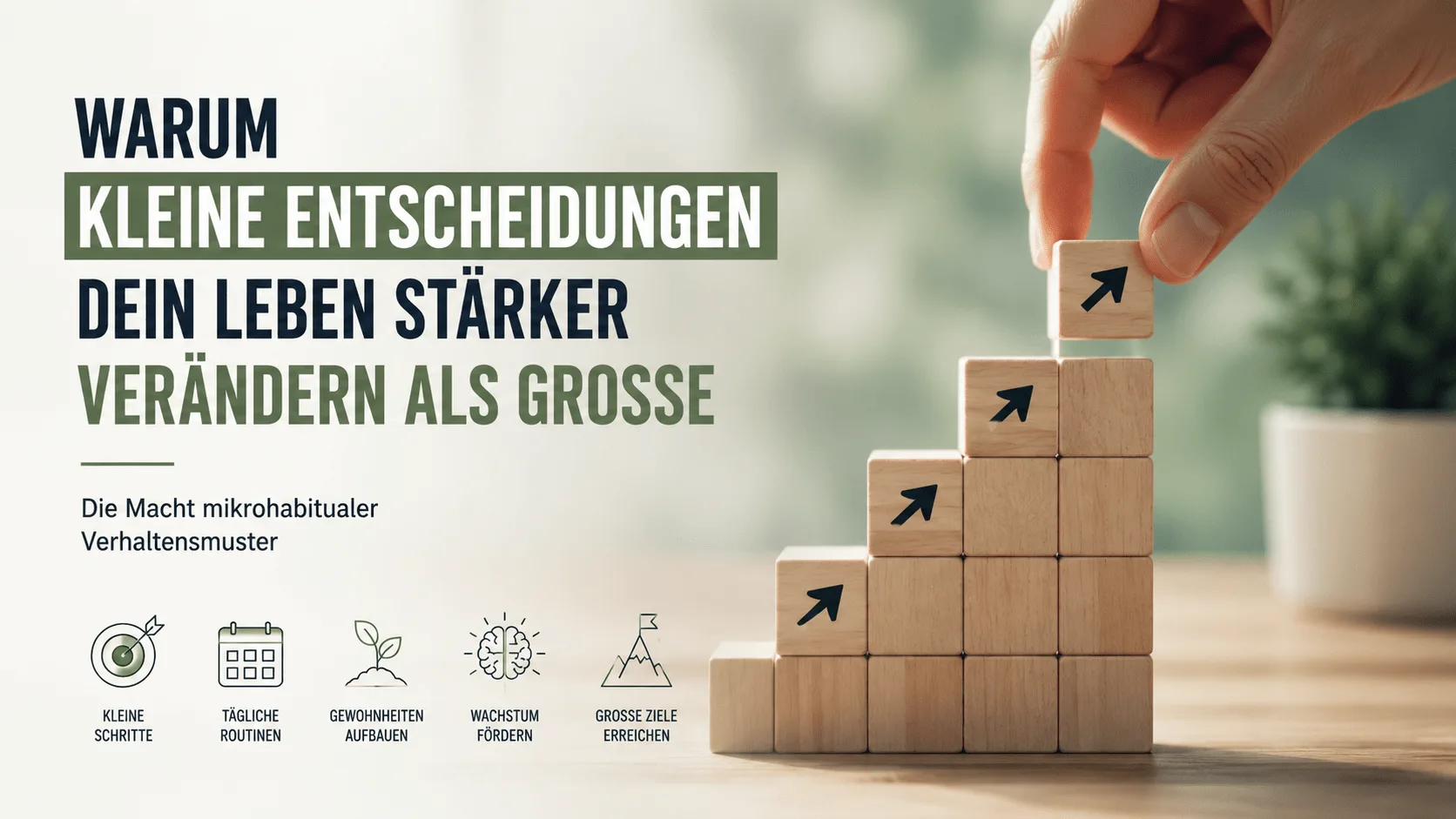
When people think about change, they mostly think about big decisions.
Taking the new job.
Ending a relationship.
Moving to another city.
Starting a company.
Quitting smoking.
These events feel significant. And of course, they can change our life.
But most lasting change doesn't come from single big decisions.
It comes from the hundreds of small decisions we make every day.
The five minutes we get up earlier in the morning.
The decision to read a chapter instead of scrolling.
The short walk after work.
Daily journaling.
The glass of water instead of a third cup of coffee.
These small actions often seem meaningless.
But over weeks, months, and years, they shape our identity, our health, our relationships, and ultimately our entire life.
In this article, you'll learn why small decisions often matter more than big life events, and how you can deliberately use the power of micro-habitual behavior patterns for your own personal development.
The illusion of the big change
Many people wait for the perfect moment.
They think:
- "Starting next month, I'll change everything."
- "Once I have more time, I'll start."
- "Next year, I'll be consistent."
In doing so, we often underestimate a decisive factor:
Life rarely changes through single turning points.
It changes through daily repetition.
A book gets written page by page.
Fitness forms workout by workout.
Self-confidence forms experience by experience.
Personal growth forms decision by decision.
Why our brain prefers small steps
Our brain loves safety.
Every change initially means uncertainty.
That's why big goals often create resistance.
For example:
- working out two hours every day
- getting up at 5am every morning
- eating completely healthy right away
- never procrastinating again
Goals like these feel motivating.
But they also feel intimidating.
Small actions, on the other hand, seem manageable.
The brain doesn't rate them as a threat.
That's exactly why micro-habits are so effective.
What are micro-habitual behavior patterns?
Micro-habits are extremely small behaviors that get repeated regularly.
Examples:
- meditating for one minute
- reading one page
- writing down one task
- drinking a glass of water
- writing down one grateful thought
- taking a five-minute walk
These actions seem unspectacular.
But their power doesn't lie in their size.
It lies in their repetition.
The math of small decisions
A single decision changes little.
But repetition creates exponential effects.
Imagine:
You read just 10 pages every day.
After a month:
300 pages.
After a year:
Over 3,600 pages.
That's roughly 12 to 15 books.
The same principle applies to:
- fitness
- learning
- relationships
- finances
- mental health
Most successes don't come from extraordinary feats.
They come from ordinary actions, carried out with extraordinary consistency.
Why small habits change identity
The real value of small decisions lies deeper.
They change our self-image.
When you read every day, you send your brain the message:
"I'm someone who learns."
When you regularly reflect:
"I'm someone who works on themselves."
When you train daily:
"I'm someone who takes care of their health."
Identity doesn't come from intentions.
It comes from evidence.
And every small action provides one more piece of evidence for who you are.
The hidden danger of big goals
Big goals have one drawback:
They direct your focus toward outcomes.
For example:
- lose 10 kilograms
- save €100,000
- start a company
This often creates a problem.
People focus on the goal and ignore the system.
But goals set the direction.
Systems determine the outcome.
Anyone who focuses exclusively on big goals often loses sight of the daily actions that actually lead to success.
Why motivation is overestimated
Many people wait for motivation.
But motivation is unreliable.
It fluctuates.
Habits, on the other hand, work even on bad days.
That's why the decisive question isn't:
"How motivated am I today?"
But:
"Which small behavior can I still carry out today?"
Small habits survive days when motivation is missing.
And that's exactly why they produce bigger results in the long run.
How micro-decisions change relationships
Small decisions don't just influence personal goals.
They also influence relationships.
For example:
- a short message of appreciation
- five minutes of active listening
- an honest conversation
- a small gesture of attention
None of these actions seem spectacular.
But relationships are rarely built through grand gestures.
They're nurtured through small moments.
Day after day.
The role of self-reflection in behavior change
Many people don't fail because of a lack of motivation.
They fail because they don't recognize their own patterns.
Because every habit begins with a decision.
And every decision is based on:
- thoughts
- emotions
- beliefs
- context
Self-reflection helps make these connections visible.
Only once we understand why we act can we make more conscious decisions in the long run.
How Mentavo can help
Mentavo was built exactly for this process.
Not for radical overnight change.
But for lasting growth through small daily steps.
- Make habits visible
-
Many small pieces of progress go unnoticed in everyday life.
Mentavo helps make them visible.
- Translate goals into daily actions
-
Big goals often feel overwhelming.
Breaking them down into small steps creates clarity.
- Journaling strengthens awareness
-
Regular reflection shows which micro-decisions actually create positive change.
- AI-supported reflection recognizes patterns
-
Mentavo helps you better understand the connections between behavior, emotions, and progress.
- Supporting long-term development
-
The focus isn't on perfection.
It's on continuous improvement.
7 micro-decisions that can change your life
-
Set one priority every morning
A clear priority increases focus and productivity.
-
Reflect for three minutes daily
Even brief reflection improves self-awareness and decision-making.
-
Read five pages before bed
Small reading habits add up surprisingly fast.
-
Write down one success after every workday
This strengthens motivation and self-confidence.
-
Take a deliberate break
Short breaks reduce stress and improve concentration.
-
Drink one extra glass of water
Small health decisions add up over the long run.
-
Show someone appreciation every day
One of the most powerful micro-habits for relationships.
Conclusion: Your life isn't shaped by single events
When we look at successful people, we often search for the big secret.
The decisive moment.
The turning point.
But most of the time, the truth lies elsewhere.
The quality of our life comes from the quality of our daily decisions.
Not once.
But again and again.
The small decision today might seem insignificant.
But together with hundreds of similar decisions, it shapes your future.
That's why you should ask yourself less often:
"What big change do I need?"
And more often:
"What small decision can I make today that my future self will thank me for?"
Because lasting transformation rarely begins with one big step.
It begins with a small step, repeated often enough.