 Mentavo
The modern self-improvement world has a problem.
It often treats people like machines.
More discipline.
More motivation.
More productivity.
More routines.
More control.
But the more people try to optimize themselves, the more often a strange feeling sets in:
Why doesn't all this knowledge actually work in the long run?
Why do people read countless books about habits —
and still keep falling back into the same patterns?
Why do so many people feel exhausted, lost, or inwardly empty despite all their motivation?
Maybe because the real problem was never a lack of information.
Maybe the problem was always
that people are too different
to work with the same solutions.
And that's exactly why the future of self-improvement might not be motivation —
but personalized AI.
The old self-improvement world was standardized
The classic self-help industry is often built on universal rules:
- the perfect morning routine
- the best habits
- the most successful strategies
- the ultimate productivity method
But people aren't standardized systems.
Every person has:
- different emotional patterns
- different fears
- different stress responses
- different motivation cycles
- different life stories
- different mental loads
- different personality structures
And yet millions of people consume the exact same generic tips.
And that's exactly where the frustration of modern self-optimization comes from:
People often try
to work with solutions
that were never really designed for them.
Motivation is unstable
Modern self-improvement culture massively overestimates motivation.
Motivation feels intense.
Almost euphoric.
An inspiring video.
A new plan.
An emotional fresh start.
A moment of clarity.
But from a neurological perspective, motivation is extremely volatile.
It depends on:
- sleep
- stress
- emotions
- energy
- dopamine
- the nervous system
- mental overload
That means:
People often build their life on an emotionally unstable foundation.
That's why many attempts at change fail — not from lack of intelligence.
But because people are trying
to build lasting systems
on short-term emotions.
People don't need generic systems — they need understanding
The real problem with modern self-optimization isn't a lack of knowledge.
It's a lack of self-knowledge.
Many people know in theory:
- how to become more productive
- how habits work
- how to set goals
- how to reduce stress
And still feel stuck.
Why?
Because behavior is never purely logical.
Behavior is emotional.
A person doesn't act based on knowledge alone.
They act based on:
- fears
- nervous-system states
- identity
- emotional patterns
- past experiences
- mental load
That's exactly why the same methods work for some people —
and not at all for others.
Personalized AI fundamentally changes the principle
For the first time, technology is emerging
that doesn't just deliver general information —
but can recognize individual patterns over the long term.
That's a fundamental difference.
Classic self-improvement systems say:
"This is how you should live."
Personalized AI could instead ask:
"How do you actually function?"
And that question changes everything.
Because real development often doesn't start with optimization.
It starts with understanding.
The future lies in pattern recognition
People are surprisingly bad at recognizing their own patterns.
Many don't notice:
- how often they criticize themselves
- when they're emotionally overloaded
- which situations exhaust them
- which relationships drain their energy
- which thoughts keep repeating
- how strongly stress changes their behavior
Why?
Because people live right in the middle of their own mental system.
The brain normalizes repetition.
That's why many inner patterns eventually become invisible.
A personalized AI, on the other hand, can recognize long-term connections:
- emotional changes
- recurring triggers
- habit patterns
- mood swings
- thinking structures
- motivation cycles
Not superficially.
But over months or years.
And that's exactly where the real value lies.
The future of AI coaching won't be loud
Many people picture AI as a constant assistant:
faster, more efficient, more productive.
But in the field of personal development, the strongest AI might be the one
that doesn't constantly push people —
but instead helps them
become more consciously aware of themselves.
Not:
"Work harder."
But:
"Why are you actually so exhausted?"
Not:
"Be more disciplined."
But:
"Which emotional patterns are sabotaging you right now?"
Not:
"Optimize your time."
But:
"Why does your life feel empty despite all this productivity?"
That's no longer classic productivity technology.
That's psychological technology.
The modern world produces overwhelm — not clarity
People today live in a state of constant mental overstimulation.
Information never stops.
Every day, people consume:
- content
- opinions
- advice
- productivity systems
- life models
- success stories
The problem:
More input doesn't automatically create more clarity.
Often, the opposite happens.
People lose themselves in:
- comparison
- overwhelm
- self-optimization
- decision paralysis
- inner pressure
The future of self-improvement, then, probably won't be about
delivering even more information.
It will be about
making the right information visible for each individual person.
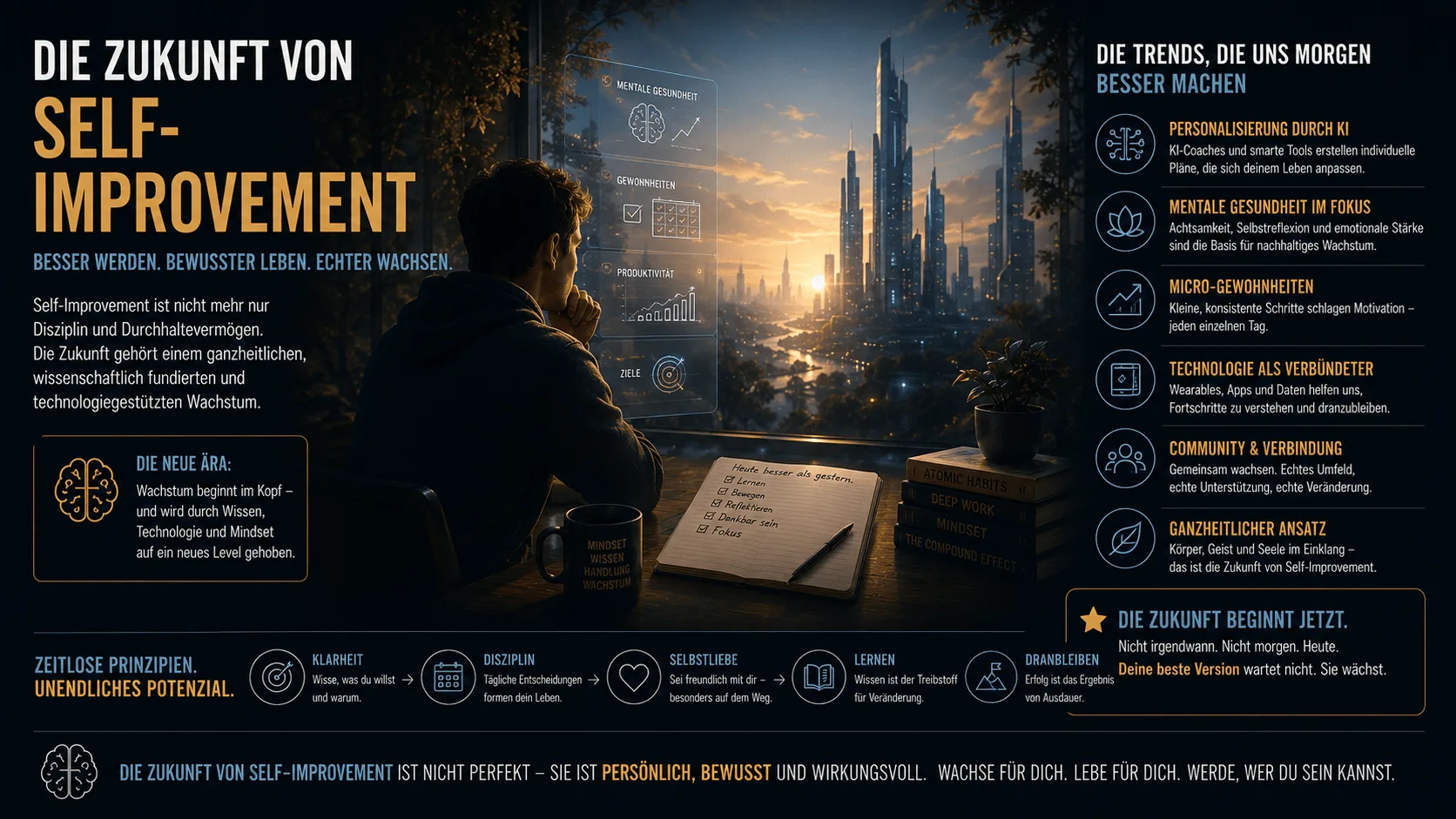
Personalized AI could scale emotional intelligence
People often understand themselves only in fragments.
Not because they're incapable.
But because self-observation is hard.
Many people function for years
without ever consciously noticing their own patterns.
A reflective AI could help, over the long term, to:
- make emotional patterns visible
- structure thoughts
- encourage self-reflection
- recognize psychological connections
- make inner processes easier to understand
Not as a replacement for therapy.
Not as a replacement for relationships.
But as a continuous space for reflection.
And that's exactly what's new.
The most dangerous form of self-improvement is self-optimization without self-understanding
Many people today try
to constantly improve themselves —
without ever really understanding
why they feel, think, or act the way they do.
That creates a dangerous state:
People optimize symptoms
while the actual emotional causes stay invisible.
They try to become:
- more productive
- more disciplined
- more motivated
even though their real problem might be:
- emotional exhaustion
- inner emptiness
- unresolved fear
- a lack of self-awareness
- chronic stress
- identity conflicts
A good, personalized AI could help exactly here.
Not just by analyzing behavior.
But by making connections visible.
The philosophical shift behind this is enormous
Maybe we're currently moving away from a world
where people simply want to become more efficient.
And toward a world
where people want to understand:
- why they feel the way they feel
- why they keep repeating certain patterns
- why they feel empty despite success
- why they constantly seem exhausted
- why they've often become strangers to themselves
That's more than productivity.
That's the development of awareness.
The future of self-improvement could become much more human
Ironically, it might be AI itself that leads people
to engage more consciously with their inner world again.
Not because machines are becoming human.
But because people are finally getting tools
that:
- listen
- reflect
- recognize patterns
- remember over the long term
- make psychological connections visible
The strongest form of AI might not be the one
that replaces people.
It might be the one
that helps people
see themselves more clearly.
This is exactly why platforms like Mentavo exist
The idea behind Mentavo isn't
to load people up with even more productivity.
It's to create an intelligent space for:
- self-reflection
- mental clarity
- AI journaling
- emotional processing
- habit awareness
- long-term pattern recognition
- personal growth
Not as a system for perfect self-optimization.
But as a personal mental operating system for people
who want to understand themselves better.
Because maybe the future of self-improvement won't be about
generating more motivation.
Maybe it will be about
finally accompanying people in a way that's more individual, more conscious, and more human.