 Mentavo
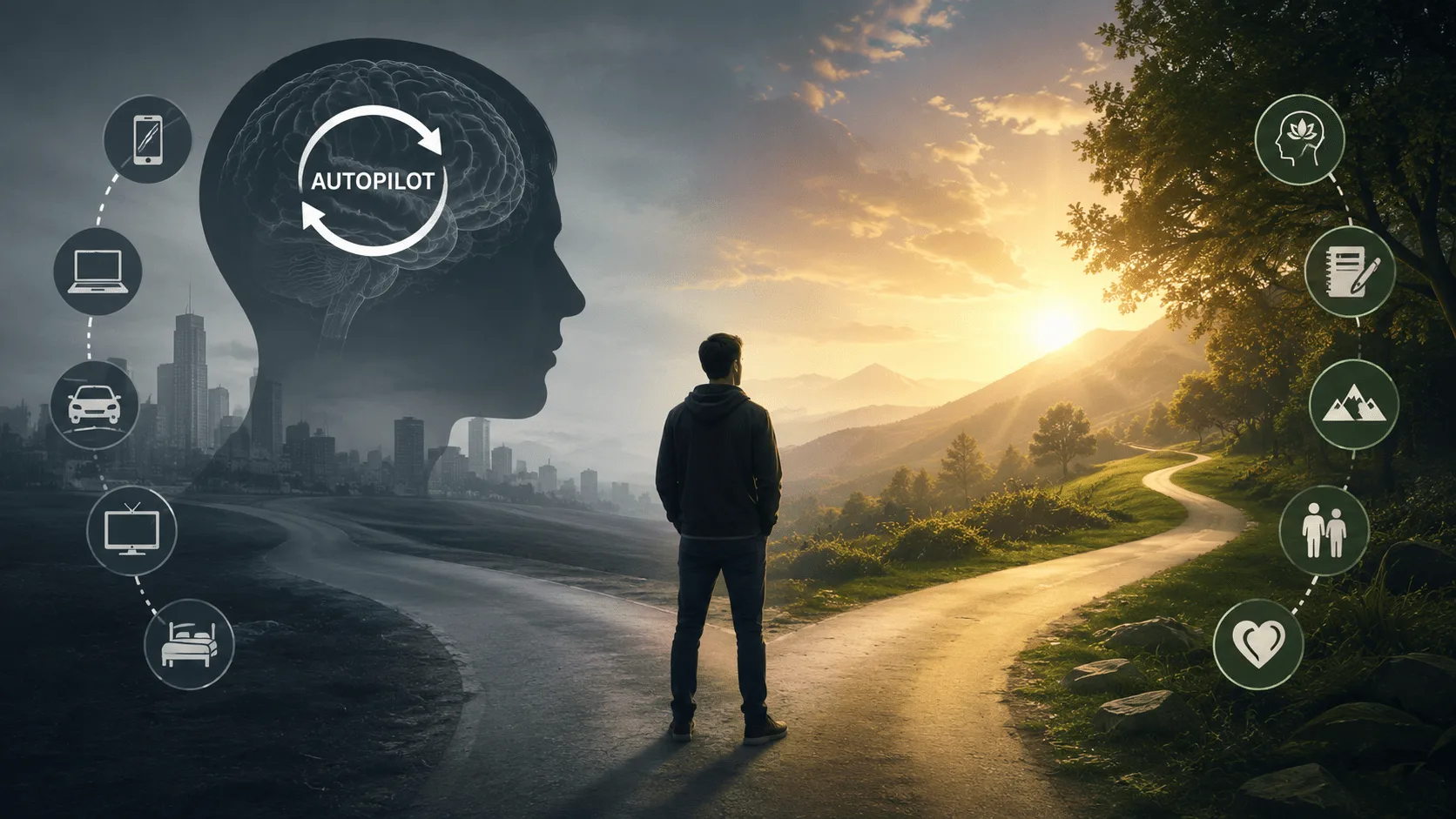
If you try tonight to remember every single moment of your day, you'll probably find that large parts of it are a blur.
You know you got up.
You know you worked.
You know you answered messages, had conversations, or got certain tasks done.
But many of the details are missing.
Not because your memory is bad.
But because your brain spends a large part of the day in autopilot mode.
In fact, neuroscientists estimate that a significant part of our behavior isn't driven by conscious decisions at all, but by habits, routines, and automatic processes.
That sounds unsettling at first.
But without this mechanism, we'd barely be able to function.
The brain loves efficiency
Every day, people make thousands of decisions.
What do I wear?
Which route do I take to work?
How do I respond to a message?
What do I eat today?
If the brain had to consciously analyze every single decision, it would quickly become overwhelmed.
So it develops shortcuts.
Once a behavior has been repeated often enough, it gets automated.
A conscious action turns into a habit.
A habit turns into a pattern.
And a pattern turns into autopilot.
This process saves enormous amounts of energy.
It allows us to carry out complex tasks without having to constantly think them through.
The price of efficiency
The problem starts where automatic patterns don't just steer our actions, but our entire life.
Many people believe they're making their decisions consciously.
In reality, they're often reacting to programs that formed years ago.
They automatically reach for their phone the moment boredom appears.
They automatically say yes even when they mean no.
They automatically respond with self-criticism when something goes wrong.
They pursue goals they've never consciously questioned.
The more often a pattern repeats, the more invisible it becomes.
And that's exactly what makes autopilot so powerful.
We barely notice our own habits
One of the brain's most fascinating traits is its ability to filter out what's familiar.
Whatever repeats constantly gets less attention.
That applies to sounds.
To smells.
To thoughts.
And even to your own behavior.
That's why it's often easier for people to spot problematic patterns in others than in themselves.
From the outside, other people's habits look obvious.
Your own, by contrast, feel normal.
Even when they've long since stopped being helpful.
Why time on autopilot passes faster
Maybe you've experienced a year suddenly feeling like just a few months.
Or wondered where the last few years have gone.
This phenomenon is closely tied to autopilot.
The brain stores new and unusual experiences much more intensely than repeating routines.
When many days play out similarly, fewer distinct memories form.
In hindsight, that stretch of time feels shorter as a result.
Not because time actually passed faster.
But because fewer conscious memories were created.
That's why childhood and adolescence feel so long for so many people.
Back then, almost everything was new.
In adulthood, routine increasingly takes over.
Autopilot protects us — and limits us
Autopilot isn't our enemy.
It's a tool.
Without it, we couldn't manage a normal daily life.
But every tool has side effects.
Because the same mechanism that lets you brush your teeth automatically in the morning also keeps you locked into thought and behavior patterns.
Many fears run on autopilot.
Many bouts of self-doubt run on autopilot.
Many relationships run on autopilot.
Some people spend years thinking the same thoughts, making the same decisions, and repeating the same emotional reactions.
Not because they consciously choose to.
But because their brain has learned that these patterns are familiar.
Why change is so hard
When people try to change their life, they're often not fighting a lack of motivation.
They're fighting automation.
Every new habit competes with existing neural connections.
The brain almost always prefers the familiar path.
Not because it's better.
But because it costs less energy.
That's why new routines feel exhausting.
That's why people fall back into old patterns.
And that's why willpower alone often isn't enough.
Change means consciously interrupting the autopilot.
Again and again.
Until a new pattern forms.
The modern world makes the autopilot stronger
It's never been easier to automate habits.
Apps are designed to capture our attention.
Algorithms learn our preferences.
Notifications steer our behavior.
Many digital products compete for exactly the same psychological mechanisms our brain already uses.
As a result, people increasingly spend time in behavior loops they never consciously chose.
They scroll.
Consume.
React.
Repeat.
And eventually wonder why they feel estranged from their own life.
Awareness is the antidote
Interestingly, the solution isn't to eliminate autopilot.
That would be impossible.
The real task is to make it visible.
Because we can only change what we recognize.
Many people experience a surprising moment when they start writing down their thoughts or consciously observing their own behavior.
Suddenly, patterns become visible.
Recurring fears.
Recurring triggers.
Recurring decisions.
What used to look like chance suddenly reveals structure.
Why Mentavo focuses exactly here
Mentavo was built to help people make these invisible patterns visible.
Through journaling, reflection, and the analysis of recurring thoughts, something emerges that often gets lost in a hectic everyday life:
Awareness.
People start to recognize which parts of their life are consciously shaped — and which just run automatically.
And that's exactly where change begins.
Not with more motivation.
Not with more discipline.
But with more awareness.
Maybe you're not living too little
Maybe you're just noticing too little of what's already happening.
Many people search for an extraordinary life.
Yet aliveness often begins in a much simpler place.
In attention.
In conscious experience.
In pausing.
In noticing what otherwise happens automatically.
Because most of our life won't be made up of the few big decisions.
It'll be made up of the thousands of small moments in between.
And maybe the art of living isn't about turning off the autopilot completely.
Maybe it's about waking up in time and noticing when it's taken over the wheel.