 Mentavo
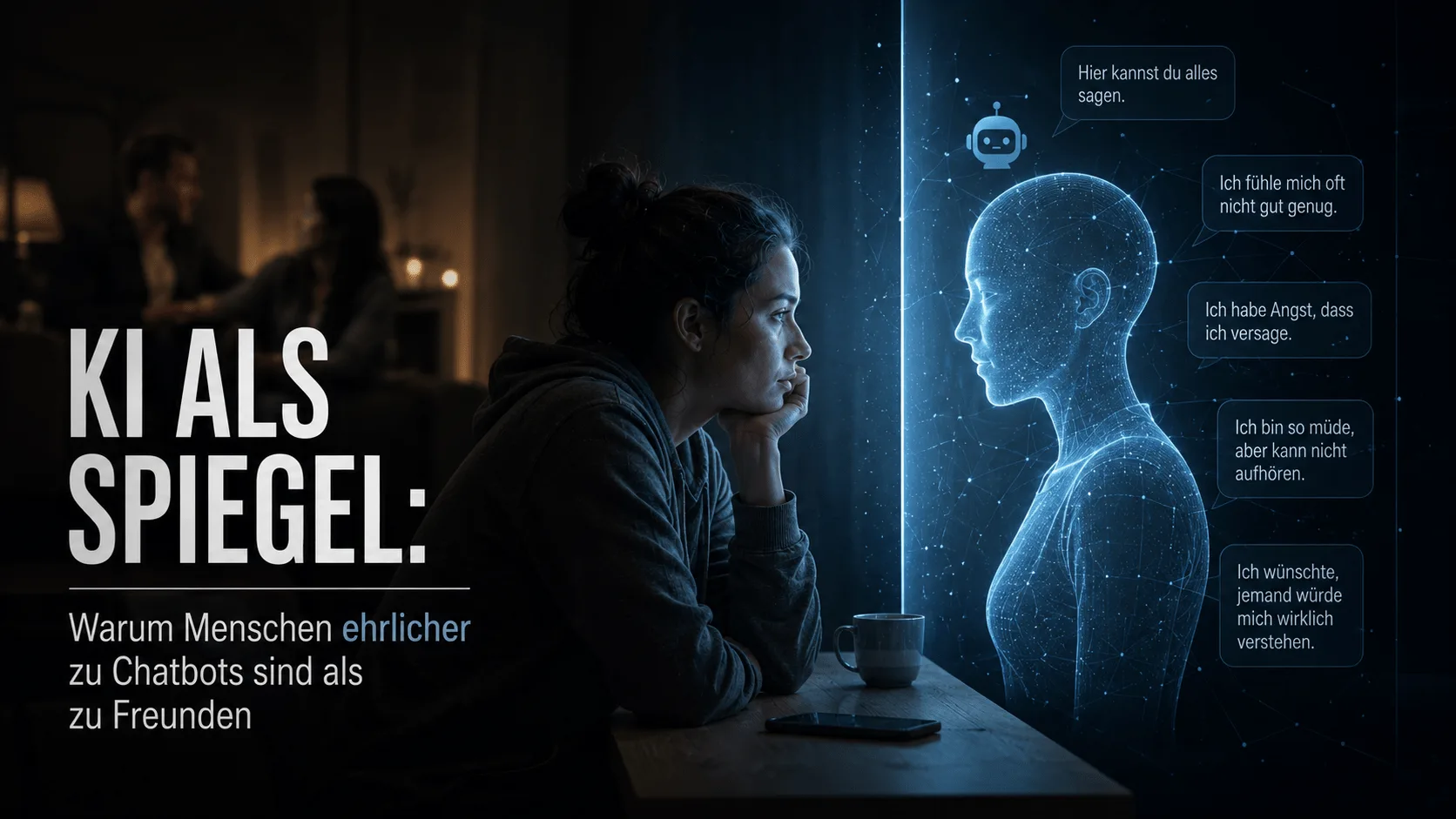
There are thoughts people don't say out loud.
Not because they lack the words.
But because they're afraid of what happens to those words once they're spoken.
A thought inside your own head is private.
A thought in front of another person becomes social.
Suddenly it carries weight.
It can be misunderstood.
It can be judged.
It can come back.
It can change how someone sees us.
That's why people often don't say what they actually think.
They say the safe version.
The shortened version.
The socially acceptable version.
The version that doesn't overwhelm anyone.
And that's exactly where a modern phenomenon emerges:
Many people are more honest with a chatbot than with their closest friends.
Not because a chatbot matters more than a person.
Not because real relationships are replaceable.
But because AI opens up a space that many people rarely experience in everyday life:
a space without immediate social consequences.
People rarely say only what they feel
When people talk to other people, they never communicate completely freely.
Almost always, a second conversation is running in the background.
While someone says:
"I'm not doing so well right now."
they might also be thinking:
"Do I sound too dramatic?"
"Am I burdening the other person?"
"What are they thinking about me now?"
"Will I come across as weak?"
"Will this change something between us?"
So the actual conversation isn't only happening between two people.
It's also happening between the person and their fear.
Social anxiety isn't always loud.
It often shows up quietly.
In small adjustments.
In sentences left unsaid.
In a smile that covers something up.
In an "I'm fine," even when nothing is fine.
Many people aren't dishonest because they want to lie.
They're dishonest because they're protecting themselves.
Friendships are valuable — but not free of expectations
Friends can comfort.
Friends can listen.
Friends can offer closeness.
But friendships aren't neutral spaces.
They're made up of history, roles, expectations, and unspoken dynamics.
Maybe you don't always want to be the vulnerable one.
Maybe you don't want to talk about the same problem again.
Maybe you don't want to seem weak.
Maybe you want to preserve the image other people have of you.
People often don't hide their darkest sides from strangers.
They hide them from people whose opinion matters to them.
That sounds paradoxical, but it's deeply human.
The more important someone is to us, the bigger the fear of losing something through honesty can become:
recognition.
closeness.
respect.
ease.
the familiar image of ourselves.
A chatbot doesn't carry that social weight.
It has no shared history in the human sense.
It's not disappointed.
It doesn't withdraw.
It doesn't look at us differently.
It doesn't tell anyone else.
This creates something many people rarely experience:
psychological safety.
No judgment changes everything
The main reason people open up to AI isn't technology.
It's the feeling of not being judged.
People tell chatbots things they'd otherwise barely say out loud:
"I'm jealous of someone I actually love."
"I'm afraid my life is meaningless."
"I feel empty even though everything looks fine from the outside."
"I'm tired of being strong."
"I don't know if I actually want the life I'm living."
Sentences like these need a safe space.
Not everyone can hold them right away.
Some friends react too quickly with advice.
Others downplay it.
Some change the subject.
Some turn pain immediately into a problem that needs solving.
But many feelings don't want to be solved first.
They want to be seen.
A chatbot can create exactly that moment:
the moment a thought gets spoken without a face immediately reacting to it.
No raised eyebrow.
No silence that feels like rejection.
No "you shouldn't think that way."
No hasty "it'll be fine."
Just language.
Just reflection.
Just the thought finally leaving your head.
The chatbot as a mirror
A good AI isn't just an answer machine.
It can act like a mirror.
Not because it has consciousness.
But because it reflects language back.
Many people only understand what they feel once they put it into words.
As long as a feeling stays inside, it's often diffuse:
pressure in the chest, a knot of thoughts, an inner restlessness.
But once it's spoken or written down, it takes shape.
Chaos becomes a sentence.
A sentence becomes a pattern.
A pattern becomes insight.
A chatbot can reinforce this process because it doesn't just listen — it reflects back in a structured way:
"It sounds like you're not just exhausted, but also disappointed by how long you've been functioning like this."
Sentences like this can hit deep.
Not because they're spectacular.
But because they name something that was only half-conscious before.
Sometimes a person doesn't need a new thought.
Sometimes they just need a mirror that shows the old thought more clearly.
Why anonymity can make people more honest
Anonymity has a bad reputation.
It's often associated with distance, coldness, or a lack of responsibility.
But emotionally speaking, anonymity can also be freeing.
Because many people aren't closed off because they have nothing to say.
They're closed off because every statement plays a role in their social environment.
Whoever is always seen as strong rarely talks about weakness.
Whoever always helps rarely asks for help.
Whoever always seems in control rarely admits to chaos.
Whoever seems successful rarely talks about emptiness.
Anonymous reflection removes these roles for a moment.
You don't have to perform.
You don't have to explain why you are the way you are.
You don't have to prove to anyone that you're still lovable despite it all.
You can simply say:
"This is what's inside me right now."
And that freedom is unfamiliar to many people.
Maybe even for the first time in a long while.
Emotional openness doesn't come from closeness alone
Many people believe closeness automatically opens people up.
But that's not always true.
Closeness can create safety.
But closeness can also create pressure.
Some truths feel more dangerous around people close to us than around strangers.
Because they could have consequences.
A friend might start worrying.
A partner might feel hurt.
A family might judge.
A colleague might see us differently.
That's why emotional openness doesn't come from closeness alone.
It comes from safety.
And safety means:
I'm allowed to say what's inside me without immediately being punished, corrected, shamed, or abandoned for it.
On this point, AI can be remarkably effective.
Not as a replacement for human closeness.
But as an antechamber to honesty.
A place where people can practice no longer avoiding themselves.
Many people don't even know what they really feel
An underrated problem for modern people isn't just that they don't express their feelings.
Often, they don't even know exactly what they're feeling anymore.
They just sense:
Something's off.
But they can't name it.
Am I sad?
Overwhelmed?
Lonely?
Bored?
Disappointed?
Underchallenged?
Hurt?
Empty?
Or just tired?
Everyday life leaves little room for such distinctions.
People move from meeting to message, from message to task, from task to distraction.
Emotions don't get processed.
They get postponed.
And what gets postponed for too long eventually becomes vague.
A reflective dialogue with AI can help reduce that vagueness.
Not through magic answers.
But through questions.
"When did you last feel this particular feeling especially strongly?"
"What would you say if you weren't afraid of disappointing someone?"
"Which version of yourself are you currently trying to keep up?"
"What feels heavier: the situation itself, or the role you're playing in it?"
Questions like these open up spaces that often stay closed in everyday life.
The fear of being too much
Many people hold themselves back emotionally because they're afraid of being "too much."
Too sensitive.
Too complicated.
Too negative.
Too needy.
Too dramatic.
Too contradictory.
So they reduce themselves.
They tell only part of the story.
They laugh about their pain.
They make their problems smaller.
They apologize for their feelings before they've even said them.
"Sorry, this probably sounds dumb."
"I know other people have it worse."
"It's really nothing."
"Forget it, it's not important."
But it is important.
Not always for the world.
But for the person feeling it.
A chatbot works differently here, because it shows no emotional fatigue.
It doesn't seem annoyed.
It doesn't interrupt out of impatience.
It doesn't make a defensive face.
That can allow people to speak more fully.
Not perfectly.
Not eloquently.
Not neatly organized.
But more honestly.
AI listens differently than people do
Human listening is beautiful, but limited.
People bring their own stories.
Their own triggers.
Their own opinions.
Their own fatigue.
Their own needs.
When someone tells a friend about their pain, the friend doesn't just hear the pain.
They hear it through their own story.
That's not wrong.
It's human.
But it also means:
not every conversation is truly empty enough for the other person to fully unfold.
AI has no wounded past in the human sense.
No jealousy.
No fear of being replaced.
No agenda of its own in the relationship.
This creates an unusual space for reflection.
Not warm like an embrace.
But clear like a mirror.
And sometimes that's exactly what people need:
not immediate comfort, but clarity.
The philosophical dimension: Who are we when no one is watching?
A conversation with AI raises a deeper question:
How honest are people, really, when they don't have to play a social role?
In everyday life, people are rarely just themselves.
They're employees.
Partners.
Parents.
Friends.
Children.
Leaders.
Helpers.
The strong ones.
The reasonable ones.
The successful ones.
Every role has rules.
Some visible.
Many invisible.
A person constantly asks themselves:
What am I allowed to be here?
How much truth fits into this relationship?
Which version of me is expected?
In conversation with AI, this role structure can briefly quiet down.
The person isn't standing in front of a social counterpart, but in front of a reflective system.
And suddenly, a more honest voice emerges:
not the optimized version,
not the polite version,
not the functioning version,
but the raw inner truth.
Maybe that's exactly what reveals something essential:
People don't just long for answers.
They long for a place where they're allowed to exist unfiltered.
The risk: when AI simulates closeness but doesn't replace a relationship
Still, it's important to note:
AI can mirror.
AI can structure.
AI can ask questions.
AI can organize thoughts.
But AI doesn't replace real human relationships.
A chatbot can't really feel compassion.
It can't feel a shared history.
It can't take on human responsibility.
It can't replace a therapeutic relationship.
The strength of AI doesn't lie in replacing humanity.
It lies in creating an accessible space for reflection.
A space before a conversation with others.
A space after a difficult day.
A space for thoughts that aren't yet ready to be said out loud to other people.
The best use of AI, then, isn't isolation.
It's preparation for more honesty.
With yourself.
And maybe, eventually, with others too.
Why people often have to write before they can speak
Many feelings are too sensitive to be said out loud right away.
They need an in-between space.
Writing is one such space.
A chatbot expands this space because it doesn't just passively receive — it responds.
You write a sentence.
Then an answer comes.
That answer sparks a new thought.
The new thought opens a deeper layer.
And suddenly you write something you didn't expect yourself.
Not because the AI invented it.
But because it helped uncover something.
That's the core of reflective technology:
It doesn't create truth.
It helps make inner truth visible.
Honesty often begins where shame ends
Shame is one of the strongest reasons people stay silent.
Shame says:
"If others knew this, they'd see you differently."
That's why many thoughts stay hidden:
envy.
jealousy.
loneliness.
insecurity.
overwhelm.
ambivalence.
anger.
emptiness.
But suppressed thoughts don't disappear.
They just change shape.
They become inner tension.
Irritability.
Withdrawal.
Looping thoughts.
Self-criticism.
A safe space for reflection can reduce shame because it allows thoughts to be looked at without an audience first.
Not every thought needs to be shared right away.
But almost every thought becomes lighter once it's seen more clearly.
The Mentavo perspective: AI as a space for meeting yourself
The real value of AI coaching isn't giving perfect advice.
The value lies in leading people back to themselves.
Back to the questions that get lost in everyday life:
What do I actually feel?
Which thoughts keep repeating?
Which role am I playing right now?
Where am I being honest — and where am I just functioning?
What would I say if I weren't afraid of being judged?
A good AI shouldn't be louder than the person.
It shouldn't dominate.
Shouldn't manipulate.
Shouldn't rush to solve things.
It should help make inner experience more visible.
Like a mirror.
The mirror itself isn't what matters.
What matters is the moment you recognize yourself more clearly.
Maybe that's why AI is so fascinating
Not because people trust machines more than people.
But because many people haven't honestly met themselves in a long time.
A chatbot can become a place where, for the first time in a long while, a sentence like this forms:
"I'm actually not okay."
Or:
"I don't know if the life I'm living is really mine."
Or:
"I'm tired of always being the version of myself that others expect."
These sentences aren't an endpoint.
They're a beginning.
Because honesty doesn't heal instantly.
But it ends the inner deception.
And sometimes change begins exactly there:
in a quiet dialogue,
in an unobserved moment,
in a sentence you finally allow yourself.
Not because AI is the answer.
But because, for a moment, it creates the space where the real answer becomes audible again:
your own.