 Mentavo
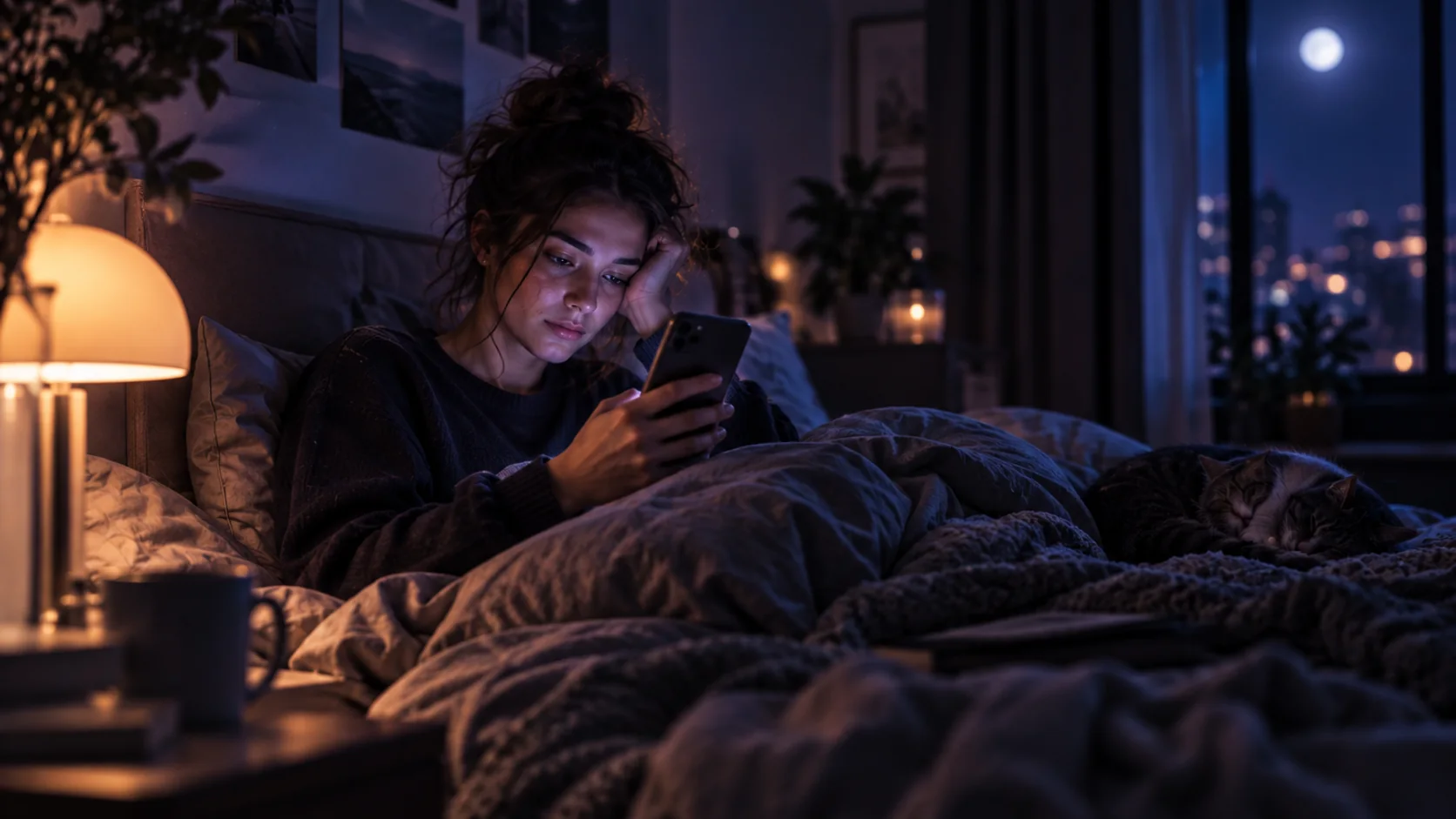
It's half past midnight. The alarm is set for half six. You're tired – not pleasantly tired, the kind where your eyes sting.
And you're still sitting there. One more episode. One more video. A quick look at the news. One more something.
By morning it makes no sense. You knew how it would go. You didn't even enjoy it. And in a few days it happens again.
Sleeping isn't an action, it's a stopping
The odd thing about going to bed: it isn't an activity you begin but one you end.
Almost everything else in a day has a start. You start working, cooking, calling someone. Sleep works the other way round – you have to stop being awake.
That sounds like a quibble and makes a practical difference. Starting something can be prompted from outside: by an appointment, an arrangement, hunger. Ending something almost always requires a decision of your own, against a state that's currently running.
And that decision comes due exactly when the resources for making decisions are lowest.
The evening as the only time that's yours
The main reason is rarely entertainment. It has to do with control.
An average day consists largely of time other people have a say in. Working hours, meetings, colleagues' requests, family needs, journeys, obligations. Even the post-work hours are often spoken for: shopping, cooking, tidying, getting a child to bed.
What remains is the time after all of that. And for the first time that day, it genuinely belongs to you.
Going to bed means ending that time – and therefore beginning the next day, which will again be made of time other people shape. From that angle, delaying isn't foolishness but holding on to the one window that isn't allocated.
Which explains an observation that's otherwise hard to follow: the late evening feels valuable even when nothing interesting is happening. It's less about the content than about who decides what happens.
Why it gets worse after demanding days
Notably, this behaviour doesn't occur evenly. It clusters after days that asked a lot.
That's consistent with the explanation above: the less of a day was self-directed, the stronger the pull to claim something back at night. If you've spent the whole day responding, you don't want to end something in the evening as well, just because it would be sensible.
At the same time, capacity to actually make that decision is lowest on exactly those days. Both effects point the same way: more need, less regulation.
That combination explains why good intentions work so badly here. They're formed on a relaxed day and would have to hold on a punishing one.
Content without an exit
Then there's the shape of what the evening usually gets filled with.
An episode ends, but the next starts automatically. A video finishes, the next is already running. A feed has no end at all. The moment at which leaving would feel natural is systematically bridged over.
That isn't a moral problem but a design one. These formats are built not to produce a natural break – and breaks are precisely what a tired person needs in order to stop of their own accord.
A book does it incidentally: the chapter ends, your eyes close, you put it down. A screen doesn't supply that moment.
Time passes differently than you think
Another factor is how time is perceived late at night.
Tired people estimate duration poorly. On top of that, the surroundings offer few reference points: same room, same light, same posture. There are no external markers from which to read how much time has passed.
Which is why looking at the clock at night is so often a surprise – and always in one direction. It's almost always later than you thought, rarely earlier.
A lot of the late evening runs automatically anyway: reaching for the remote, continuing to scroll, the getting-up that doesn't happen. Automatic sequences produce no conscious decision points – and without such points, nothing interrupts the continuing.
What's actually being extended
The most useful question isn't how to get to bed earlier but what the late evening delivers.
The answers differ a lot:
- Autonomy. Time in which nobody wants anything. Then it isn't about entertainment but about control.
- Quiet. The first silence of the day. Then the need is already met – what's missing is the exit.
- Distraction. Something unpleasant is pending or on your mind. The screen keeps it at a distance.
- Solitude. After a day full of people, the evening is the first stretch without anyone opposite you.
- Reward. A punishing day shouldn't just end as though it cost nothing.
The distinction matters because it points to different responses. If you're after autonomy, a stricter bedtime gains you nothing – it sharpens the problem. If you're after quiet, you could have it earlier. If you're avoiding something, the subject isn't sleep at all.
Why a fixed hour rarely does it
The standard advice is to set a fixed bedtime. That can help, but it doesn't reach the place where the behaviour originates.
An hour is a rule about the moment of stopping – the hardest point of the evening. It demands self-regulation exactly when the least of it is available.
Usually it's more effective to change the evening before that. If self-directed time starts earlier, it doesn't need stretching to one in the morning. If there's an hour between obligations and bed that unambiguously belongs to you, the hour after it loses significance.
That isn't a trick but a shift: the need isn't fought, it's met earlier.
What becomes observable over weeks
On a single evening it's hard to say what the cause was. The day? The hour work ended? A conversation? Or simply habit?
Over several weeks a picture emerges. You might notice it happens more on certain weekdays, or after days with particular features – few breaks, many meetings, a late finish.
That's what check-ins, routines and the journal in Mentavo are for: not to grade bedtimes, but to make evenings comparable at all. When energy, mood and the shape of the day are recorded regularly, it becomes possible to see in hindsight which days end differently from others.
If it turns out certain kinds of days coincide more often with late nights, that says nothing about causes. But it says something about where a change might start – and that's usually earlier in the day than half past midnight.
What this article doesn't claim
Not every late night is bedtime procrastination. Some people are simply more awake in the evening and sleep later – that's a rhythm, not a behaviour in need of correction.
More importantly, this piece says nothing about sleep disorders. Lying awake unable to fall asleep, waking during the night, or being exhausted during the day despite adequate sleep is a different matter. That belongs with a doctor and can't be settled by self-observation.
The term "revenge bedtime procrastination", popular in recent years, shouldn't be made to explain everything here either. It describes a pattern, not a diagnosis – and it doesn't fit every late evening.
Conclusion: it's rarely about sleep
Someone who is tired and stays up isn't behaving irrationally. They're holding on to something the rest of the day didn't provide.
Which is why the resolution to go to bed earlier so often leads nowhere. It treats the hour, not the reason.
The more useful question isn't: "Why don't I just go to sleep?"
But: "What should have happened earlier today so this evening wouldn't have to be so long?"