 Mentavo
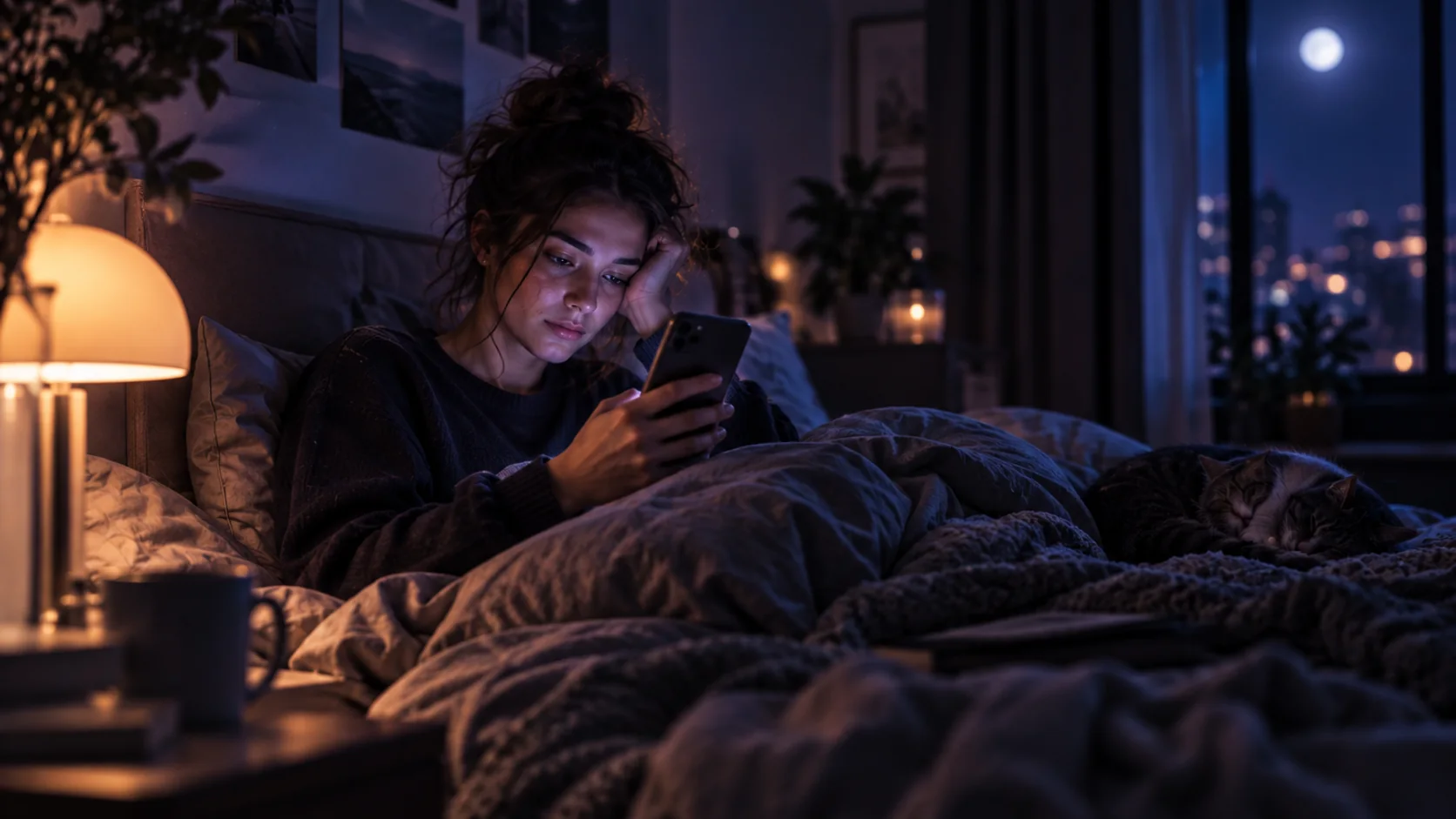
You picked up your phone to check one thing. Answer a message, look at the time, search for something.
And then, at some point: phone down, eyes up, and that odd moment of reorientation. It's much later than you thought. And you could barely say what you read in that hour.
The obvious explanation is a lack of discipline. It's rarely the most interesting one. The same person who stops without difficulty elsewhere can't find the exit here. So the better question isn't whether scrolling is good or bad – it's why stopping is so hard when you already wanted to.
What's missing: an ending
Almost everything else we consume has a form with a built-in end.
A book has pages. A film has credits. A newspaper has a last page. Even an episode finishes and demands a deliberate decision if you want another.
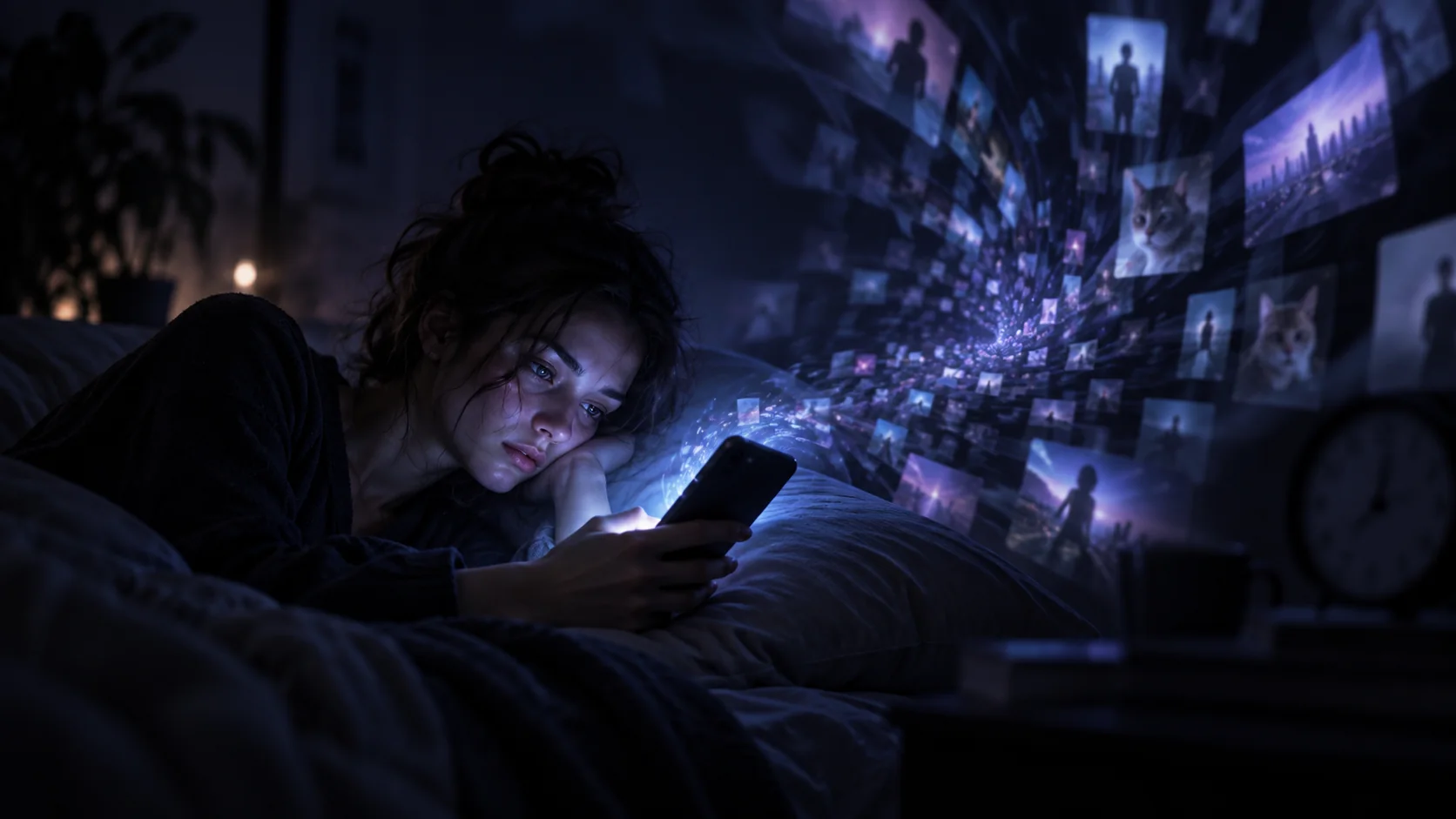
A feed has none of that. It isn't built to be finished. There's no point at which something signals: that's it.
That sounds trivial and isn't. In this environment, stopping requires an independent, active decision – not once, but repeatedly. With a book, attention ends on its own. With a feed, it has to be interrupted every single time, against a stream that simply keeps running.
Why unsettling content sticks so well
"Doomscrolling" doesn't just describe long scrolling but getting caught on the alarming: crises, conflicts, bad news.
That isn't pessimism. Information about possible danger is, reasonably enough, more relevant to us than information about things that are fine. Knowing where a problem is makes it possible to respond. So attention drifts toward what looks threatening rather than toward what reassures.
For most of history this caused no trouble, because the supply was limited. There were as many unsettling stories as fitted in a newspaper or in fifteen minutes of broadcast.
Today the supply is effectively unlimited. The attentional mechanics are unchanged; the stock isn't. You can search for the next worrying detail as long as you like and you'll always find one.
The search that never concludes
Part of the scrolling comes from a need that is, in itself, sensible: you want to know where you stand.
When a situation is unclear – politically, medically, professionally, personally – looking for information is a reasonable response. Knowing more usually means judging better.
The trouble starts when the question isn't answerable by information at all. "How will this turn out?" has no answer sitting somewhere in the feed. So you keep looking, keep finding fresh takes, and the uncertainty stays exactly where it was – sometimes larger than before.
That explains a contradiction plenty of people recognise: you feel worse after scrolling and start again the next evening anyway. Not because it helped last time, but because the need underneath was never met. Research has looked at, among other things, how hard people find it to tolerate uncertainty and how that may bear on behaviour like this – though it isn't a simple relationship.
What happened immediately before
More revealing than the scrolling itself is often the moment just before it.
Almost nobody consciously decides to scroll for an hour. Reaching for the phone happens in a gap: between two tasks, after a draining conversation, in a waiting room, on the sofa when the day is over but your head isn't.
Those gaps have different qualities, and the differences are worth noticing:
- Idle time. Five minutes with nothing due – too short to start something, too long to do nothing.
- Depletion. Your head is full but not tired enough to sleep. Scrolling demands no effort, but it fills.
- Avoidance. Something unpleasant is waiting. The phone is a legitimate reason not to begin it yet.
- Tension. A conversation, a message, an open question. The feed distracts for a while.
The same action – phone in hand – can arise from any of these states. Which is exactly why blanket advice so rarely lands: someone scrolling out of depletion needs something different from someone scrolling out of avoidance.
Why your sense of time disappears
The striking thing about long scrolling isn't the duration but that you don't notice it.
Time perception needs reference points. We estimate duration from how much has changed: new rooms, new people, a completed piece of work, a trip to the kitchen. Scrolling supplies almost none of these markers. Same posture, same light, same format, one post after another.
Without reference points, estimates fall systematically short. It feels like ten minutes because ten minutes and fifty minutes look similar from the inside. Only the clock corrects it – often by a surprising margin.
There's a familiar side effect too: attention that hops between many short stimuli leaves few memory traces. You've seen a lot and retained little. Afterwards that deepens the sense that the time simply vanished.
Why "just one more" doesn't work
"Just one more video" is sincerely meant. It describes a real intention.
What it underestimates is how such a decision has to be made. At the end of a post the next one is already there – not in a minute, immediately. The window in which "stop" would have to be chosen is therefore extremely short.
And that window falls in a phase when self-regulation isn't at its best anyway. Late evening, after a long day, with a tired head. It isn't that the decision goes the wrong way. Often it simply isn't made, because nothing calls for it.
What can be observed instead of forbidden
The standard suggestion is to delete apps or set screen-time limits. For some people that works. For many it holds a few days and then collapses, because the triggers are unchanged.
A different approach doesn't start with a rule but with an observation. Not "I scroll too much", but:
- What times of day does it happen most?
- What came immediately before – a conversation, a task, a wait, the end of the working day?
- How was my energy that day, before it started?
- Were there days when it barely happened – and what was different about them?
These questions are unglamorous, but they yield something no rule can: a sense of what the scrolling actually stood in for that evening.
Where check-ins can contribute
Connections like these are nearly invisible in the moment. You don't notice it was the third demanding workday in a row – you only notice you were on your phone longer again.
Across several weeks it looks different. When mood, energy, time of day and the shape of the day are recorded regularly, a picture forms that shows more than memory does. That's what check-ins and journal entries in Mentavo are for: not to grade behaviour, but to make it comparable in the first place.
If it becomes visible that certain days coincide more often with long evenings on the phone – low-energy days, say, or days that ended late – that's no proof of a cause. Two things occurring together don't explain each other. But it's a far better starting point than resolving to do better tomorrow.
Small changes aimed at the mechanism
If the problem is the missing endpoint, the most direct response is to create one – not as a prohibition, but as a form.
That can look very ordinary. After scrolling, deliberately do something with a duration of its own: stand up, get a glass of water, open a window. Not as a reward, but as a marker – something that gives time perception a reference point again.
It can help just as much to fill the gap beforehand. If you know the half hour after dinner reliably ends in the feed, that stretch can be given a different shape. Not necessarily a productive one – doing nothing is a shape too, if it's intended. The difference between automatic and deliberate behaviour rarely lies in effort, but in whether a decision was made at all.
What this article doesn't claim
Long scrolling is not a clinical condition and not evidence of addiction. There are phases when it happens often and phases when it barely features.
Nor can it be said generally that digital media worsen mood. The relationships differ from person to person and depend heavily on what's being read, in what state, and instead of what.
Conclusion: the question isn't the time, it's the gap
The hour that disappears is rarely the real subject. What's more interesting is what didn't happen in that hour – and what it replaced.
Cutting the evening short without knowing that gap usually just fills it with something else. Knowing it lets you decide what fits there better.
So perhaps the most useful question after a long evening on your phone isn't: "Why didn't I stop again?"
But: "What did that stand in for?"