 Mentavo
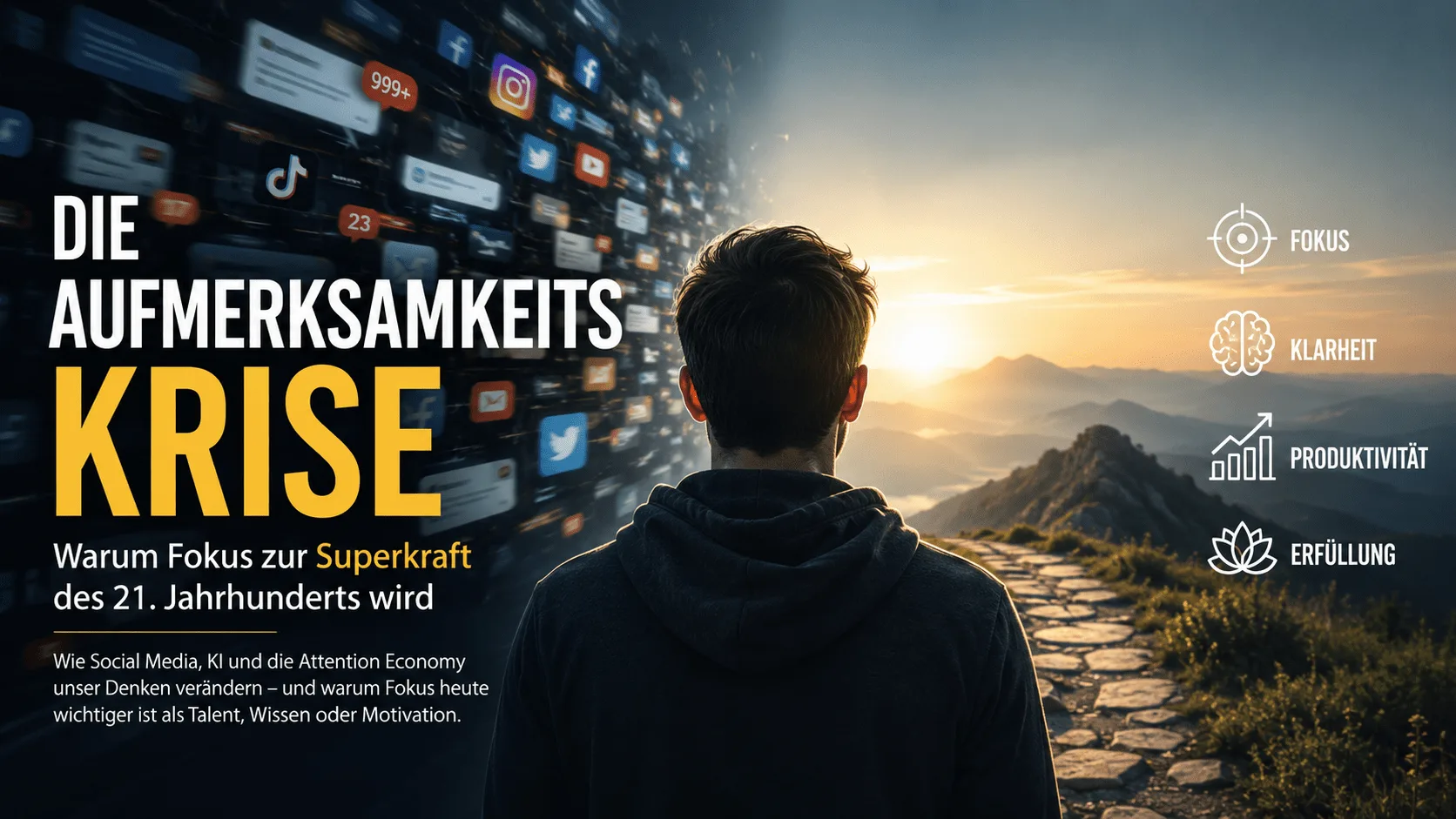
Introduction: The most valuable resource isn't time – it's attention
The same battle starts every morning.
Before we even get up, we're scrolling through news, social media feeds, emails, and notifications. While we work, we switch between chats, meetings, browser tabs, and AI tools. In the evening, the next video, the next post, or the next algorithm takes over our attention.
We live in a world where everything is competing for our attention.
The result:
- Attention spans are shrinking.
- Distractions are increasing.
- Mental exhaustion is becoming the norm.
- Deep thinking is becoming rarer.
At the same time, a new paradox emerges:
Never before have we had so much knowledge available – and never before has it been so hard to concentrate on what actually matters.
In 2026, focus is becoming one of the most valuable skills there is. Whoever can control their attention gains a decisive advantage – professionally, personally, and mentally.
What is the attention economy?
Companies used to compete for money.
Today, they compete for attention.
Every platform, every app, and every algorithm pursues the same goal:
More screen time. More interactions. More engagement.
Because attention can be monetized.
Social media platforms make money when we stay longer.
Streaming services make money when we keep watching.
Ad networks make money when we click.
Our attention has become a commodity.
The problem:
Our brain wasn't built for a world where thousands of stimuli compete for our attention every single day.
Why our brain loves focus – and hates distraction
The human brain works best in what's known as deep-focus phases.
In these moments:
- we learn faster,
- we solve complex problems,
- we develop creative ideas,
- we make better decisions.
But every time we check a notification or switch between tasks, our brain pays a price.
Neuroscientists call this the context switching cost.
Switching between different tasks costs mental energy.
That's why we often feel busy even though we've accomplished little.
We're not working too little.
We're switching too often.
The role of social media
Social media has revolutionized our information landscape.
But the mechanisms behind it are also changing how we think.
Algorithms optimize content for:
- Clicks
- Likes
- Comments
- Time spent
This produces content designed to maximize attention.
Often, that means:
- short bursts of stimulation,
- emotional statements,
- controversial opinions,
- quick dopamine hits.
The problem:
Our brain gets used to constant stimulation.
Longer periods of concentration suddenly feel exhausting.
Reading a book becomes harder.
A complex project feels overwhelming.
Even a 10-minute focus block feels unfamiliar.
Why AI both improves and worsens the situation
Artificial intelligence is radically changing how we work.
On the positive side:
AI can help us
- find information faster,
- automate routines,
- prepare decisions,
- increase productivity.
But there's also a downside.
The easier knowledge becomes to access, the more important it becomes to know how to use it wisely.
AI provides answers.
Focus decides which questions we ask.
AI generates content.
Focus decides which content is relevant.
AI speeds up processes.
Focus decides the direction.
In an AI-driven world, attention becomes the real competitive advantage.
The new elite won't be the most intelligent
Many people believe the future belongs to those with the most expertise.
Something else is more likely, though:
The most successful people will be those who can control their attention.
Why?
Because knowledge is now available everywhere.
Discipline is becoming rare.
Focus is becoming rare.
Deep thinking is becoming rare.
And that's exactly why its value keeps rising.
While others constantly react, focused people plan deliberately.
While others consume, they create.
While others get distracted, they stay on course.
The hidden cost of distraction
Most people underestimate the consequences of constant distraction.
They often don't show up right away.
Instead, over time, they lead to:
- Less creativity
-
Creative ideas usually emerge during longer periods of thinking.
Constant interruption prevents this process.
- More stress
-
Open tasks and constant stimuli increase mental strain.
- Worse decisions
-
Under time pressure, our brain relies more often on short-term solutions.
- Lower satisfaction
-
People experience flow states mainly during focused work.
Without focus, the sense of progress and fulfillment often drops too.
Why self-optimization alone isn't enough
Many productivity guides promise:
- better to-do lists,
- new time-management systems,
- more efficient workflows.
But often, the real problem lies elsewhere.
It's not organization that's missing.
It's the ability to consciously direct attention.
Before we can become more productive, we need to learn:
to actively protect our attention.
Because focus doesn't happen by accident.
It's the result of conscious decisions.
How Mentavo can help
This is exactly where modern self-development apps like Mentavo come in.
Instead of adding more and more tasks, it's about creating clarity.
Mentavo combines several areas for this:
- Daily reflection
-
Check-ins and journaling make it visible where your attention is actually going.
- Goals instead of reactions
-
Clear goals help align decisions with long-term priorities.
- Building habits
-
Focus isn't a one-time achievement.
It comes from daily routines.
- AI as a coach instead of a distraction
-
The built-in coaching feature supports reflection, planning, and personal growth – without the endless stream of information typical of classic social media platforms.
- Making progress visible
-
Recognizing how small steps create long-term change keeps you more motivated and focused.
5 practical strategies for more focus in everyday life
-
Start the day without social media
The first minutes of the day often shape your attention for the hours that follow.
Avoid direct consumption and start with deliberate planning instead.
-
Work in focus blocks
25 to 90 minutes of concentrated work is often more productive than several hours full of interruptions.
-
Reduce open decisions
The fewer decisions you have to make, the more mental energy stays available for what matters.
-
Use technology deliberately
Not every notification deserves your attention.
Technology should serve you – not the other way around.
-
Reflect daily
Whoever observes their attention can steer it over time.
Just a few minutes of daily reflection make a big difference.
Conclusion: Focus is becoming the decisive skill of the future
The attention crisis isn't a passing trend.
It's a direct consequence of our digital world.
Social media, AI, and the attention economy will keep growing in the years ahead.
That's why focus keeps becoming more valuable.
Not because attention itself is becoming scarce.
But because deliberate attention is becoming scarce.
Anyone who learns to direct their thoughts, set clear priorities, and deliberately reduce distractions develops a skill that can barely be automated.
In a world full of information, the winner isn't the one who consumes the most.
It's the one who can concentrate on what matters.
Focus is no longer just a productivity technique.
Focus is the superpower of the 21st century.