 Mentavo
Do you know these situations?
Someone makes a seemingly harmless remark – and suddenly you feel hurt, angry, or insecure.
A colleague criticizes some small detail, and you're still thinking about it hours later.
Your partner replies briefly to a message, and doubt or insecurity immediately sets in.
Looked at objectively, these situations are often unremarkable.
Subjectively, they feel enormously intense.
Why?
Because it's not the situation itself that triggers the strong reaction.
It's something the situation activates inside us.
Psychologists call this phenomenon an emotional trigger.
In this article, you'll learn how emotional triggers form, why some people react especially strongly to them, and how you can learn to use triggers as a tool for personal growth.
What is an emotional trigger?
An emotional trigger is something that sets off a strong emotional reaction.
That reaction can be:
- Anger
- Fear
- Shame
- Insecurity
- Sadness
- Disappointment
- Helplessness
The key point:
The current situation is usually only the trigger – not the actual cause.
The trigger often activates older experiences, memories, or beliefs stored deep in our emotional system.
That's why two people often react completely differently to the same situation.
Why do some situations feel so intense?
Imagine someone criticizes your work.
Objectively, the comment might be factual and helpful.
And yet you might immediately feel:
- Defensiveness
- Frustration
- Self-doubt
- The urge to withdraw
Why?
Because the brain doesn't just evaluate the current situation.
It unconsciously compares it to past experiences.
If criticism was once linked to rejection, punishment, or being devalued, the same emotional alarm system gets activated again.
So the brain isn't just reacting to today.
It's reacting to the past at the same time.
Our brain's emotional time machine
One fascinating aspect of emotional triggers:
They often send us unconsciously back into an earlier emotional state.
An adult can suddenly feel like:
- the child who never got enough recognition,
- the teenager who was excluded,
- the person who was once hurt or let down.
That's why triggers often feel irrational.
Part of the reaction belongs to the present.
But a large part belongs to past experiences.
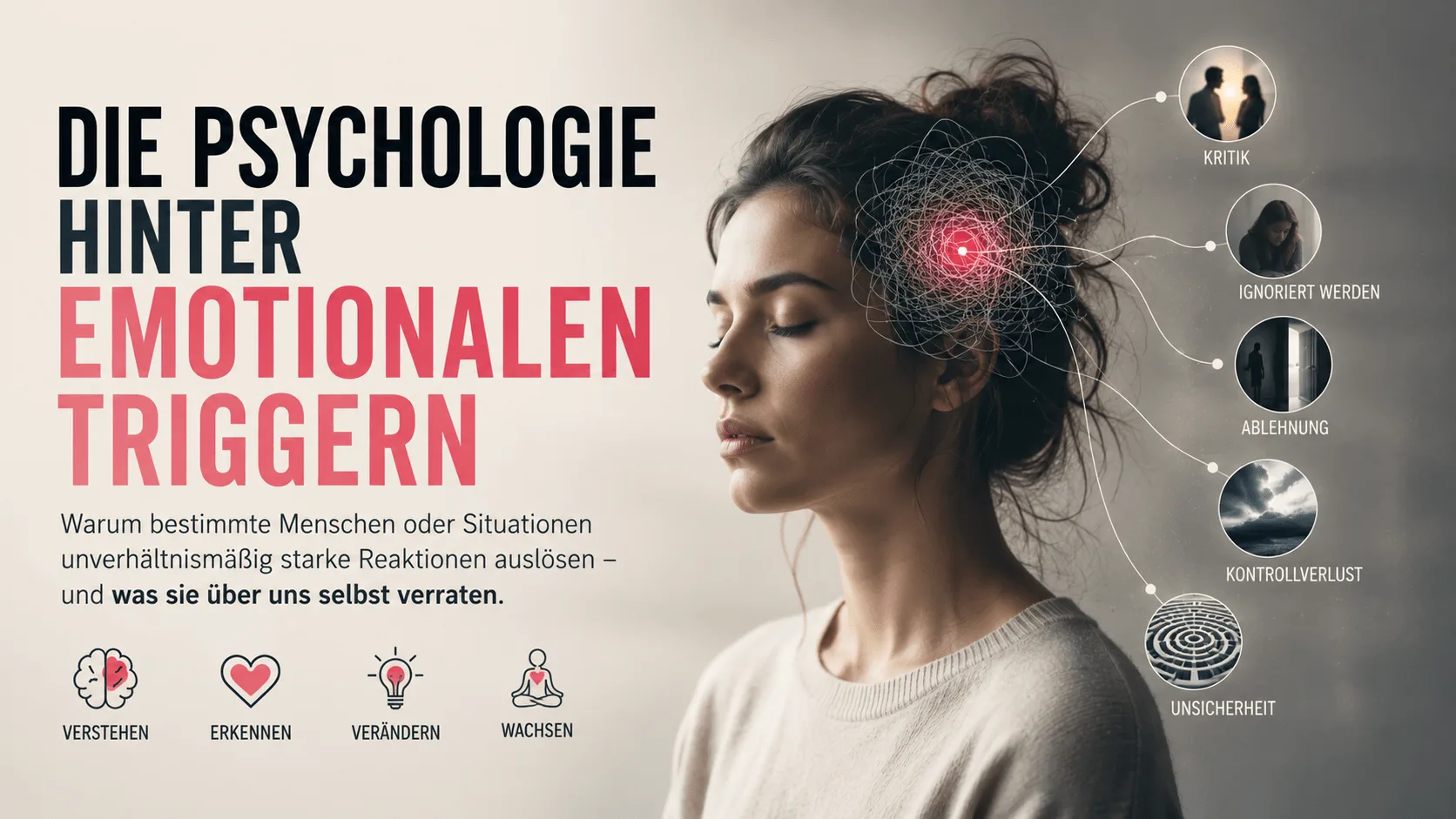
The most common emotional triggers
Criticism
Many people are especially sensitive to criticism.
Behind the reaction is often the fear:
"I'm not good enough."
Typical thoughts:
- "I failed."
- "Others think badly of me."
- "I have to be perfect."
Being ignored
An unanswered message or a lack of attention can trigger strong feelings.
Possible underlying beliefs:
- "I don't matter."
- "I'll be left behind."
- "I get overlooked."
Loss of control
Some people react very strongly to uncertainty or unexpected change.
Behind it is often a deep need for safety.
Rejection
Even small rejections can trigger intense emotions.
For example:
- Being turned down
- Criticism of an idea
- A lack of approval
The actual pain often doesn't come from the situation itself, but from old experiences of rejection.
Injustice
People with a strong sense of fairness often react especially sensitively to perceived unequal treatment.
Earlier experiences of powerlessness frequently play a role here.
Why triggers aren't a bad thing
Many people try to avoid triggers.
But triggers aren't the problem.
They're signals.
They show us the areas where emotional issues still need attention.
You could say:
Triggers are signposts from our subconscious.
They reveal where old wounds, fears, or beliefs are still active.
Anyone who learns to understand their triggers gains valuable information about themselves.
The question that changes everything
The next time you react strongly on an emotional level, ask yourself this question:
"What am I really hurt by?"
Not:
- What did the other person do?
But:
- Why does this affect me so strongly?
Often, this question opens the door to a deeper understanding.
What emotional triggers reveal about your beliefs
Behind many triggers are unconscious beliefs.
For example:
| Trigger | Possible underlying belief |
|---|---|
| Criticism | I'm not good enough |
| Rejection | I'm not lovable |
| Being ignored | I don't matter |
| Making mistakes | I'm not allowed to fail |
| Conflict | Harmony is necessary to be accepted |
As long as these beliefs stay unconscious, they influence our behavior.
Anyone who recognizes them can start to question them.
The difference between reaction and reflection
Emotional reactions happen automatically.
Reflection happens consciously.
There's a crucial moment between trigger and action.
The bigger that moment becomes, the more emotional freedom you gain.
Instead of reacting immediately:
- observe,
- notice,
- understand.
This is exactly where emotional intelligence begins.
How Mentavo can help
Emotional triggers can rarely be changed through willpower alone.
The key lies in continuous self-observation.
Mentavo supports this process on several levels.
Daily reflection instead of automatic reaction
Regular check-ins help you notice emotional reactions earlier.
Over time, this reveals patterns that often stay hidden in everyday life.
Journaling makes triggers visible
Many people only recognize their emotional triggers once they've documented their thoughts and feelings over a longer period.
Over time, connections become visible:
- Which situations trigger strong emotions?
- Which people trigger certain reactions?
- Which thoughts keep repeating?
AI-supported reflection
Mentavo's coaching features help you look at recurring emotional patterns from a new perspective.
This often leads to insights that stay hidden in everyday life.
Long-term development instead of short-term control
The goal isn't to no longer have triggers.
The goal is:
Being able to handle them consciously.
Mentavo helps you understand your emotional reactions better, step by step, and build new patterns of thinking and behavior.
6 practical steps for working with triggers
1. Notice the reaction
Consciously name what you're feeling.
For example:
- Anger
- Fear
- Shame
- Disappointment
2. Pause briefly
Don't respond right away.
Don't act right away.
Often just a few minutes of distance is enough.
3. Separate the situation from the past
Ask yourself:
"How much of my reaction actually belongs to the current situation?"
4. Identify the underlying need
Maybe what's behind it is:
- Safety
- Recognition
- Belonging
- Appreciation
5. Document recurring patterns
Write down your triggers regularly.
This makes long-term patterns visible.
6. Respond with compassion instead of self-criticism
Triggers don't mean something is wrong with you.
They simply point to areas that deserve attention.
Conclusion: Triggers are messages, not enemies
Most people experience emotional triggers as disruptive.
In reality, though, they can be among the most valuable sources of personal growth.
Because triggers show us:
- where old wounds are still active,
- which beliefs are influencing us,
- which needs remain unmet.
Anyone who understands their triggers gains more than emotional control.
They gain self-knowledge.
And that's exactly where lasting growth begins.
Not by suppressing uncomfortable feelings. But by learning to understand their message.