 Mentavo
Every person feels emotions.
We feel joy, fear, frustration, insecurity, disappointment, or anger.
But even though we experience our emotions every day, we often understand them surprisingly little.
We say things like:
- "I'm just in a bad mood."
- "I don't know why this is bothering me so much."
- "I feel off, but I can't explain it."
- "Something is weighing on me."
The emotion is there.
But its cause stays hidden.
This is exactly where a crucial difference lies:
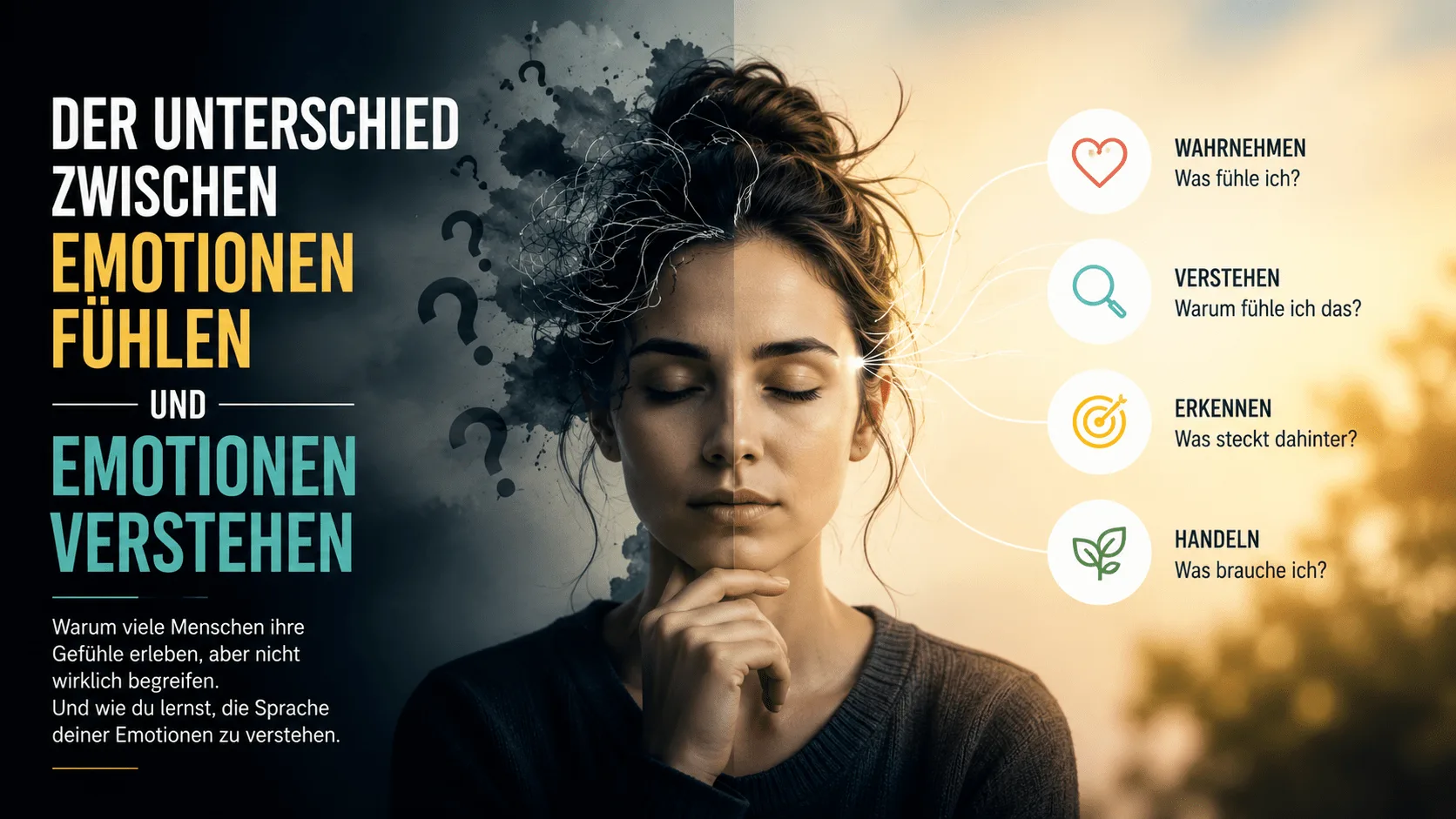
Between experiencing an emotion and understanding an emotion.
Many people spend their lives experiencing feelings without ever learning what those feelings are actually trying to tell them.
Yet emotional understanding is one of the most important skills for mental health, personal growth, and fulfilling relationships.
In this article, you'll learn why emotions are often misunderstood, why simply noticing a feeling isn't enough, and how you can learn to truly understand the language of your emotions.
Why feeling alone isn't the same as self-knowledge
Emotions arise automatically.
We don't have to learn how to feel afraid.
We don't have to practice feeling sad.
Emotions are part of being human.
Understanding is something else entirely.
Understanding means:
- recognizing the cause,
- identifying the trigger,
- understanding the underlying needs,
- correctly interpreting the emotional message.
Many people stop at the first step.
They feel.
But they don't reflect.
As a result, emotions often become something that just happens.
Instead of something that can be understood.
An everyday example
Imagine a colleague criticizes your work.
You immediately feel:
- Anger
- Defensiveness
- Frustration
Most people stop right there.
They think:
"That criticism made me angry."
But emotional understanding goes deeper.
Possible questions would be:
- Why does this criticism hit me so hard?
- What thoughts come up because of it?
- What fear does it activate?
- What past experience does it remind me of?
Maybe it suddenly becomes clear:
The anger isn't actually the real feeling.
Underneath it is insecurity.
Or the fear of not being good enough.
Or the worry of not being recognized.
The emotion stays the same.
But the understanding changes everything.
Emotions are messages, not problems
Many people see feelings as an obstacle.
Especially uncomfortable emotions.
Yet emotions serve an important function.
They deliver information.
You could say:
Emotions are the internal navigation system of our life.
Every emotion points to something.
- Fear
-
Signals possible uncertainty or danger.
- Anger
-
Draws attention to violated boundaries or injustice.
- Sadness
-
Helps process loss.
- Guilt
-
Can point to a conflict with your own values.
- Joy
-
Often shows that important needs are being met.
Someone who only feels emotions experiences these signals.
Someone who understands emotions can use them.
Why many people don't understand their feelings
We rarely learn emotional education
In school, we learn:
- Mathematics
- Languages
- Sciences
But almost no one learns:
- how to recognize emotions,
- how to identify needs,
- how to understand inner conflicts.
Because of this, many adults have extensive technical knowledge but only a limited emotional vocabulary.
We mistake thoughts for feelings
A common mistake:
People describe thoughts instead of emotions.
For example:
"I feel ignored."
That's not actually an emotion.
It's an interpretation.
The real question is:
What do I feel because I feel ignored?
Maybe:
- Sadness
- Disappointment
- Loneliness
- Insecurity
This is where real emotional understanding begins.
We avoid uncomfortable feelings
Many people try to get rid of difficult emotions as quickly as possible.
Through:
- Distraction
- Social media
- Work
- Entertainment
- Constant busyness
The problem:
Suppressed emotions rarely disappear.
They stay active until they're understood.
The difference between emotional reaction and emotional insight
Emotional reaction means:
I feel something.
Emotional insight means:
I understand why I feel it.
This distinction is crucial.
Because only what is understood can be lastingly changed.
Someone who understands their emotions recognizes:
- recurring patterns,
- personal triggers,
- unresolved conflicts,
- unmet needs.
This opens up new possibilities for action.
The three levels of emotional understanding
Level 1: What am I feeling?
The first step is naming the emotion.
For example:
- Anger
- Fear
- Shame
- Disappointment
- Sadness
Many people already skip this step.
Level 2: Why am I feeling this?
Now it's about the trigger.
What situation activated the emotion?
What thoughts came up?
Level 3: What's underneath it?
The most important level.
This is about:
- Needs
- Values
- Beliefs
- Past experiences
This is often where we discover the real cause.
It's not the situation that hurts us.
It's what it touches inside us.
Why emotional clarity changes your life
People with high emotional clarity experience the same feelings as everyone else.
The difference:
They're less controlled by them.
They can:
- make more conscious decisions,
- resolve conflicts more effectively,
- maintain healthier relationships,
- manage stress more effectively.
Emotional clarity doesn't mean feeling less.
It means understanding better.
How Mentavo can help
Emotional insight rarely happens in a single moment.
It comes through continuous reflection.
This is exactly where Mentavo comes in.
Daily check-ins support emotional awareness
Regular reflection helps you not just notice feelings, but consciously name them.
This creates more emotional clarity.
Journaling makes connections visible
Many emotional patterns only become visible once thoughts and feelings are documented.
Over time, this reveals:
- recurring triggers,
- typical reactions,
- emotional patterns.
AI-supported reflection creates new perspectives
Mentavo helps you look at emotional connections from a different angle.
This often leads to insights that stay hidden in everyday life.
Long-term development instead of short-term emotion control
The goal isn't to suppress feelings.
The goal is to understand them better.
Because understanding creates change.
5 questions to help you understand your emotions better
The next time you notice a strong emotion, ask yourself:
-
What exactly am I feeling right now?
Not just "bad" or "good".
What specific emotion is there?
-
What triggered this emotion?
What situation came before it?
-
What thoughts came up?
What am I telling myself about the situation?
-
What need might be behind it?
Is it about:
- Safety?
- Recognition?
- Belonging?
- Freedom?
- Respect?
-
Is this reaction only about the current situation?
Or does it remind me of earlier experiences?
Conclusion: Feelings only become valuable through understanding
Emotions are part of our life.
Yet many people spend their whole lives stuck at the level of feeling.
They experience their emotions.
They react to them.
They fight against them.
But they don't understand them.
And it's precisely in understanding that the real power lies.
Because every emotion contains information:
about our needs,
about our values,
about our experiences,
about ourselves.
Learning to decode this information builds a skill that goes far beyond emotional control.
It builds self-knowledge.
And that's exactly where lasting personal growth begins.
Not when we stop feeling.
But when we start understanding.