 Mentavo
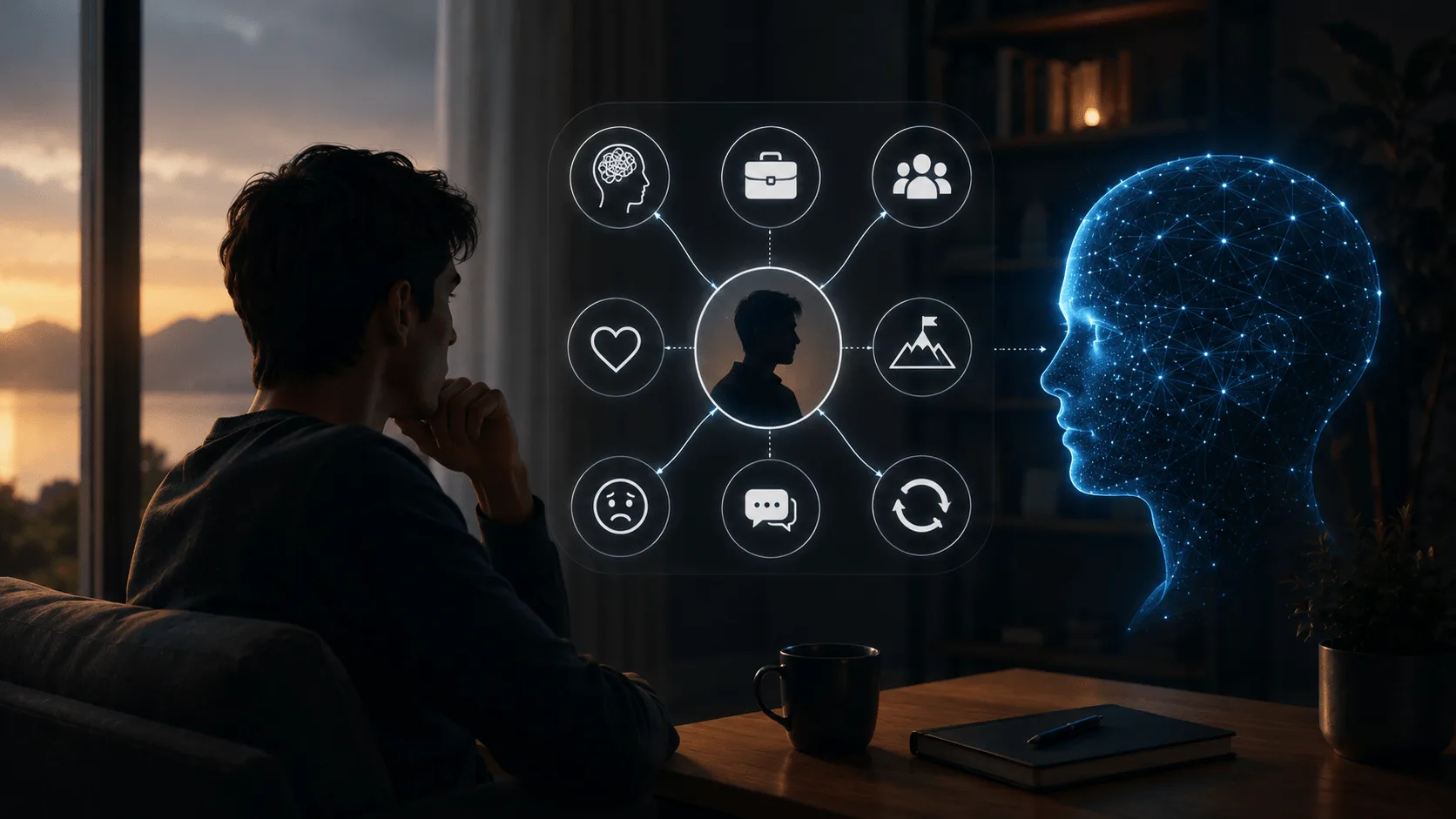
Most people believe they know themselves pretty well.
They know what they like. What they don't like. Which goals they're pursuing. Which values matter to them. After all, they spend every day with themselves.
And yet there's something remarkable about the human psyche:
We're often the last person to recognize our own patterns.
Other people sometimes notice earlier that we're stressed. They see behaviors that don't stand out to us at all. They recognize recurring mistakes that we keep explaining away or justifying.
Psychologists call these hidden areas of our personality blind spots.
They're traits, behavior patterns, or emotional dynamics that are visible to others, but remain remarkably hard for us to recognize in ourselves.
So the interesting question isn't whether we have blind spots.
The interesting question is whether artificial intelligence could one day help make them visible.
The problem with self-perception
People don't view themselves objectively.
That's not a flaw.
It's a natural part of how our brain works.
Our perception is constantly shaped by memories, emotions, beliefs, and personal stories. We don't see the world as it is. We see it through the lens of our own experiences.
As a result, we overvalue some traits and overlook others.
We remember situations that confirm our self-image.
Contradictory information, by contrast, often gets downplayed or ignored.
Someone who considers themselves especially rational, for instance, will often interpret emotional decisions differently. Someone who considers themselves independent might not notice how strongly outside opinions influence their own behavior.
The brain doesn't always protect the truth.
It often protects identity.
Why others see things we overlook
Every person views their life from a first-person perspective.
We experience thoughts, feelings, and intentions directly. Other people, by contrast, mostly see our behavior.
Interestingly, blind spots often form exactly at this intersection.
We judge ourselves by our intentions.
Others judge us by our actions.
Maybe you believe you're open to criticism. But others might experience you as defensive.
Maybe you see yourself as helpful. But others notice that you struggle to set boundaries.
Maybe you consider yourself spontaneous. But your decisions have followed the same patterns for years.
The truth often lies somewhere between the inside and the outside perspective.
Why AI could be in a unique position
An AI has neither a person's inner perspective nor their outer one.
It has something else.
It can analyze large amounts of information over long periods of time.
While people mostly remember individual situations, an AI can look at hundreds or thousands of entries, conversations, decisions, and behavior patterns at once.
It recognizes repetitions.
Connections.
Deviations.
Patterns that are too complex or too long-term for the human brain to track.
If, for example, someone keeps describing the same fears, experiencing the same conflicts, or pursuing the same goals without getting any closer to them over months, an AI could make these repetitions visible.
Not because it's more intelligent.
But because it observes differently.
The patterns we don't see ourselves
Many people believe their problems are separate from one another.
Stress at work.
Conflicts in relationships.
Difficulty with motivation.
Recurring self-criticism.
But often, these themes are connected.
Maybe the same fear lies beneath all of these problems.
The same insecurity.
The same behavior pattern.
People experience their life day by day. As a result, much of it feels isolated.
An AI, by contrast, could recognize over years that seemingly different problems keep tracing back to the same underlying cause.
That would be comparable to a psychologist who can perfectly remember every single conversation.
The future of self-reflection
Today, many people use journaling, coaching, or therapy to understand themselves better.
These tools will remain important in the future.
But AI could add a new layer.
Not by handing out answers.
But by asking questions no one else would think to ask.
Why has this theme kept coming up for three years?
Why do conflicts always arise under similar conditions?
Why do you set yourself the same goals every year?
Why do certain emotions keep repeating in the same situations?
Questions like these can be surprisingly uncomfortable.
But that's exactly where the most valuable insights often emerge.
The risk involved
Of course, this development also raises important questions.
An AI can recognize patterns.
But patterns aren't automatically truth.
People are complex.
Context matters.
Irony.
Personal history.
Emotional nuance.
Not every repetition means a problem.
Not every correlation means a cause.
The risk lies in mistaking patterns for certainties.
A good AI shouldn't judge, then.
It should reflect.
Not tell you who you are.
But show you what it observes.
Why self-knowledge often comes from outside
Interestingly, many of life's most important insights already come from mirrors today.
From conversations.
From feedback.
From books.
From other people.
We rarely discover our biggest blind spots entirely on our own.
We need something that gives us a different perspective.
Maybe AI will become exactly that kind of perspective.
Not as a replacement for human relationships.
Not as a replacement for therapy.
But as an additional tool for self-understanding.
Why Mentavo is thinking exactly in this direction
Mentavo is built on a simple idea:
People understand themselves better once their patterns become visible.
Through journaling, reflection, and long-term memory functions, a personal record of your own life gradually forms — not to judge people, but to recognize connections.
Which thoughts keep coming up?
Which goals have followed you for years?
Which fears never fully disappear?
Which themes are developing?
With enough context, an AI could eventually make visible patterns that even the user themselves has never noticed.
Not because it knows the person better.
But because it remembers better.
Maybe it's not about AI knowing you
Many discussions about artificial intelligence revolve around the question of how much AI will one day know about us.
Maybe that's the wrong question.
Maybe the more interesting question is:
How much will you learn about yourself once an AI helps you make your own patterns visible?
Because the biggest changes rarely come from new information.
They come from new perspectives.
And maybe the best AI systems of the future won't be the ones that have an answer to every question.
They'll be the ones that help us recognize the questions we would never have asked ourselves.